







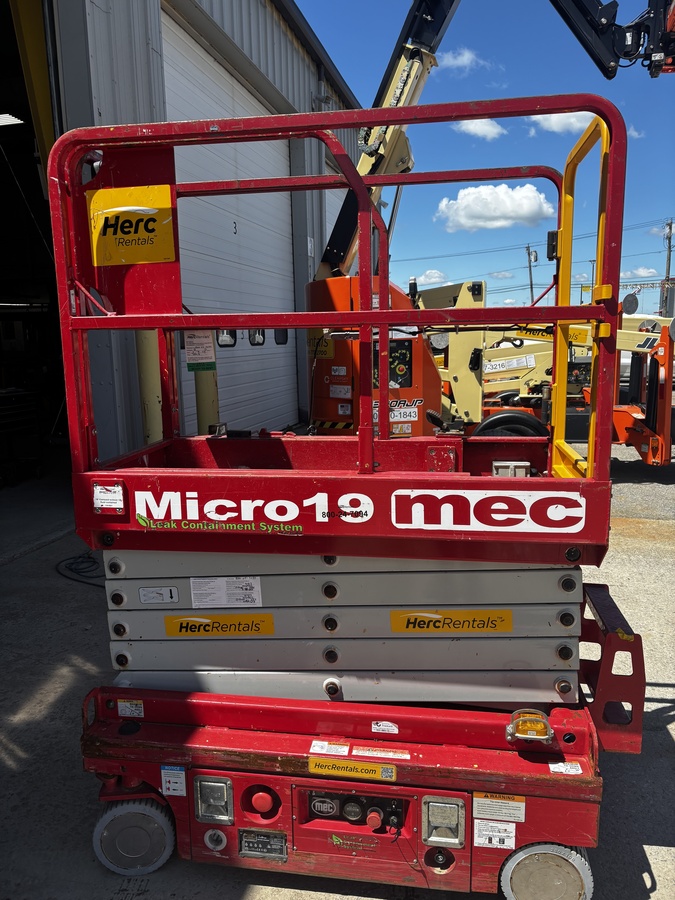
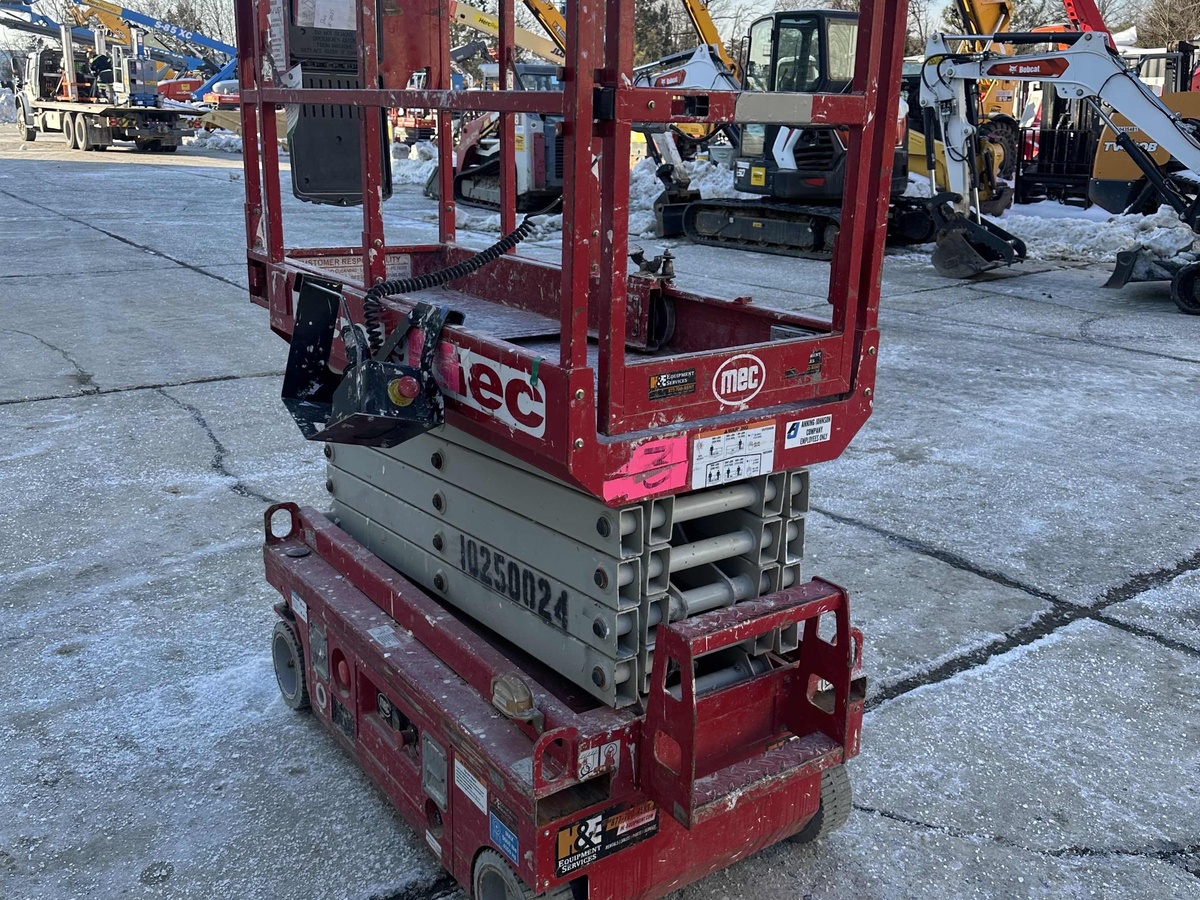
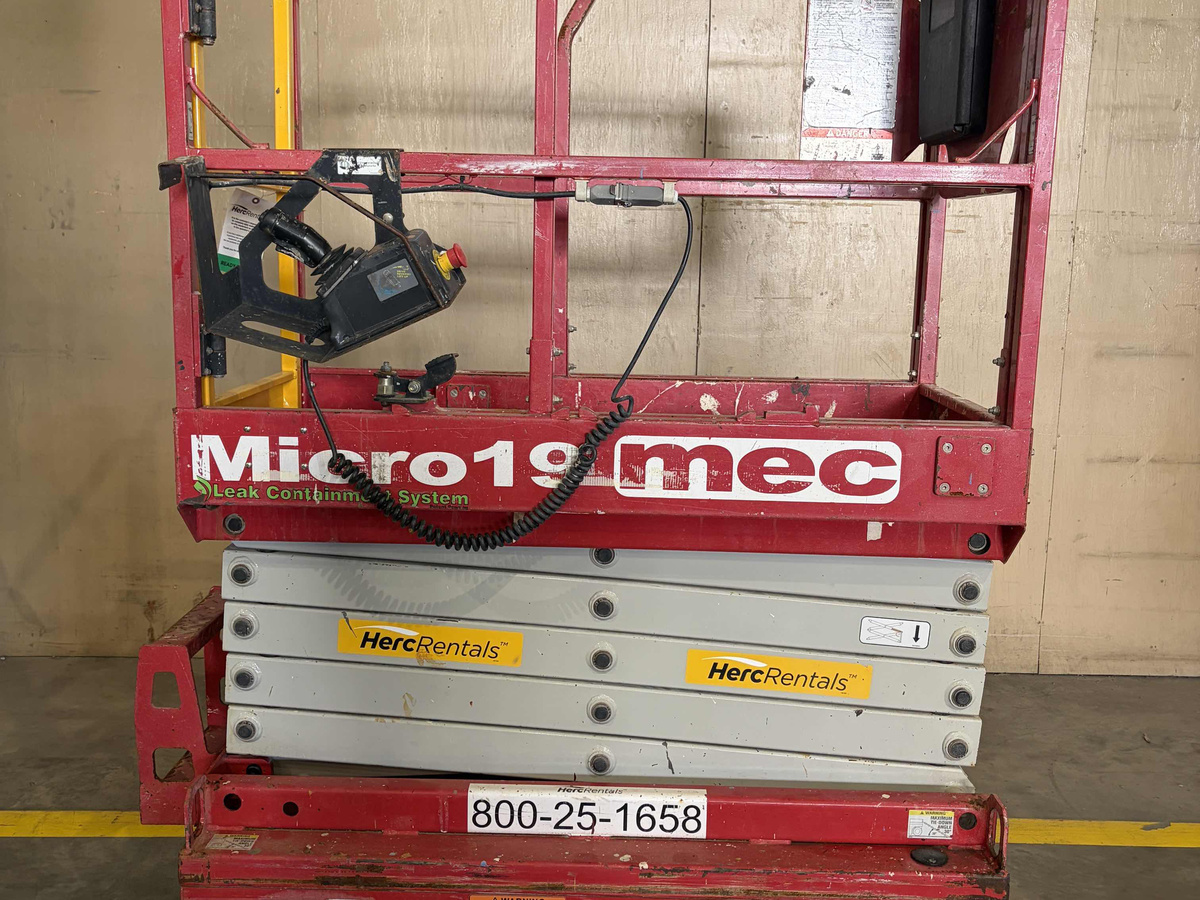
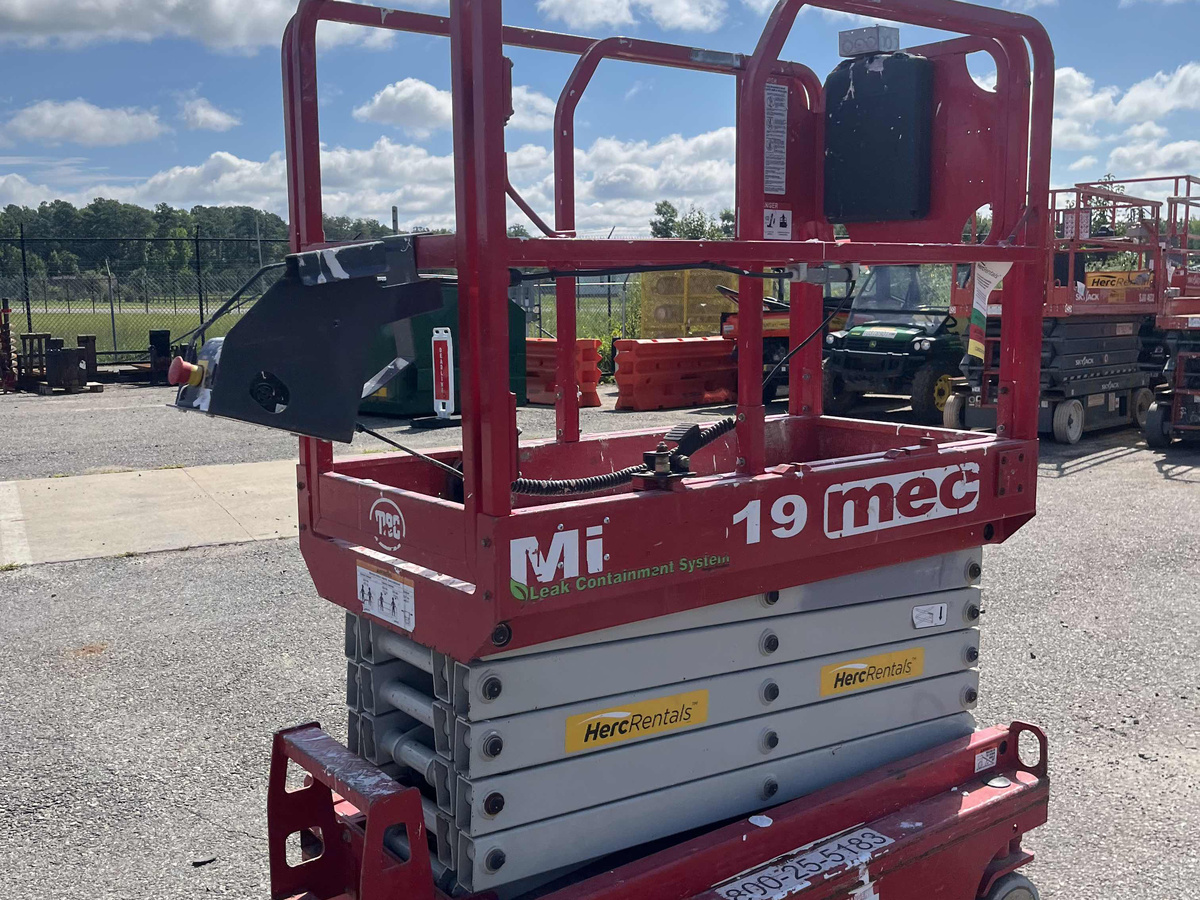
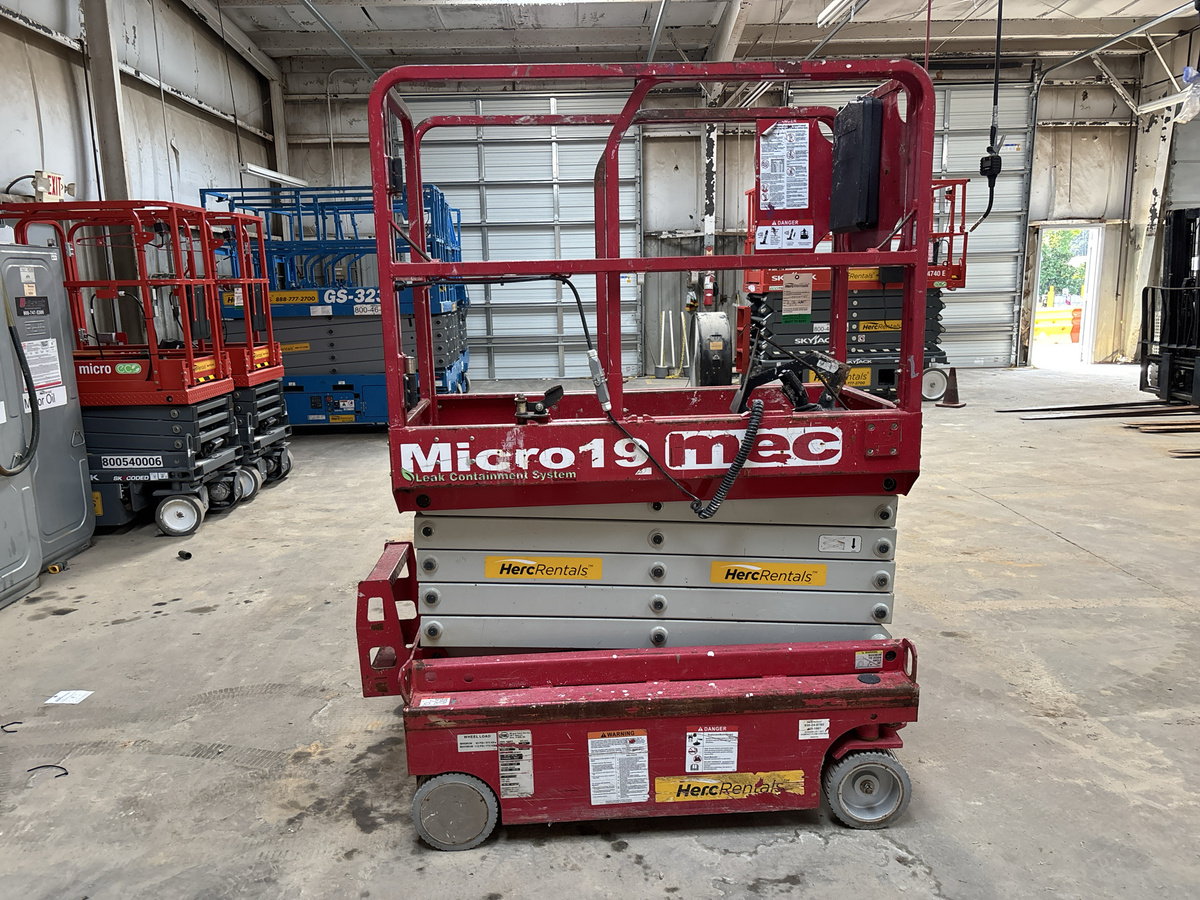


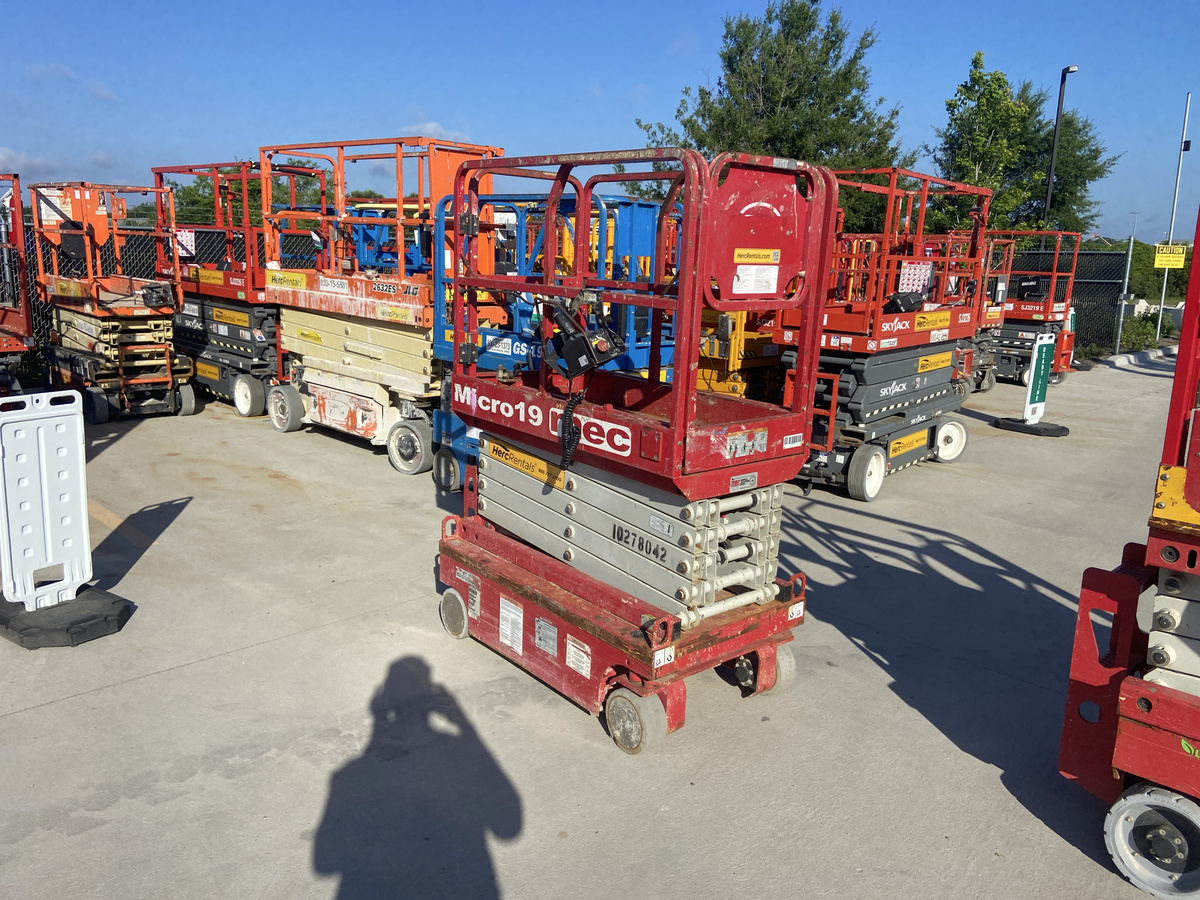
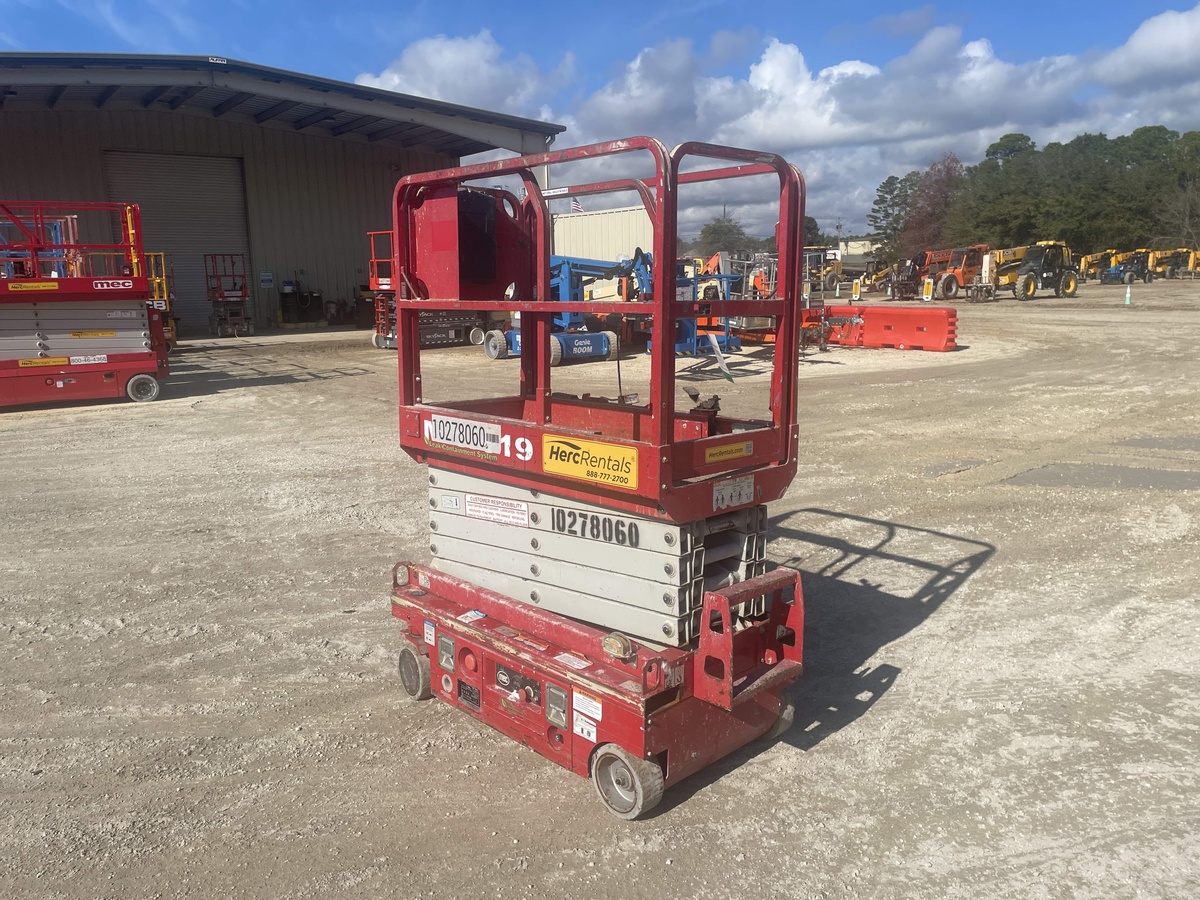
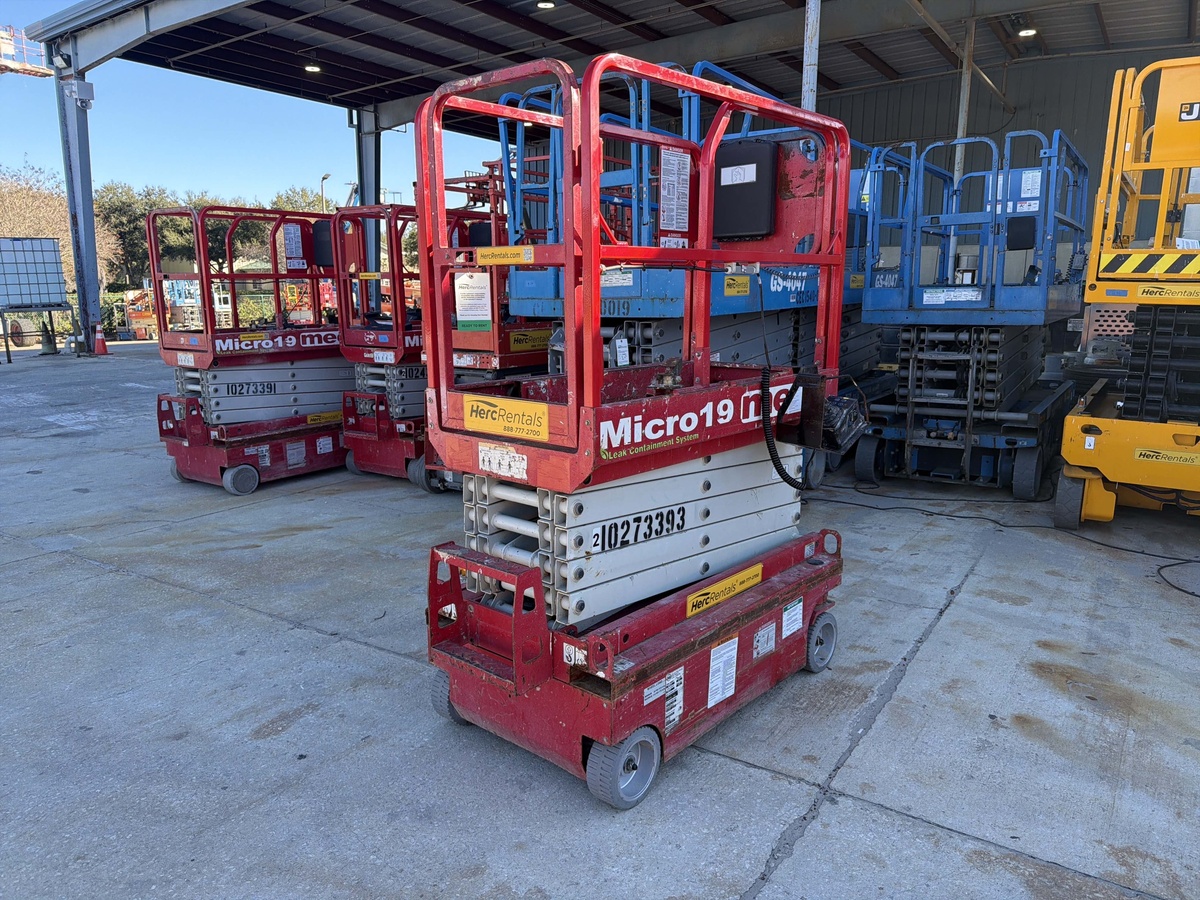


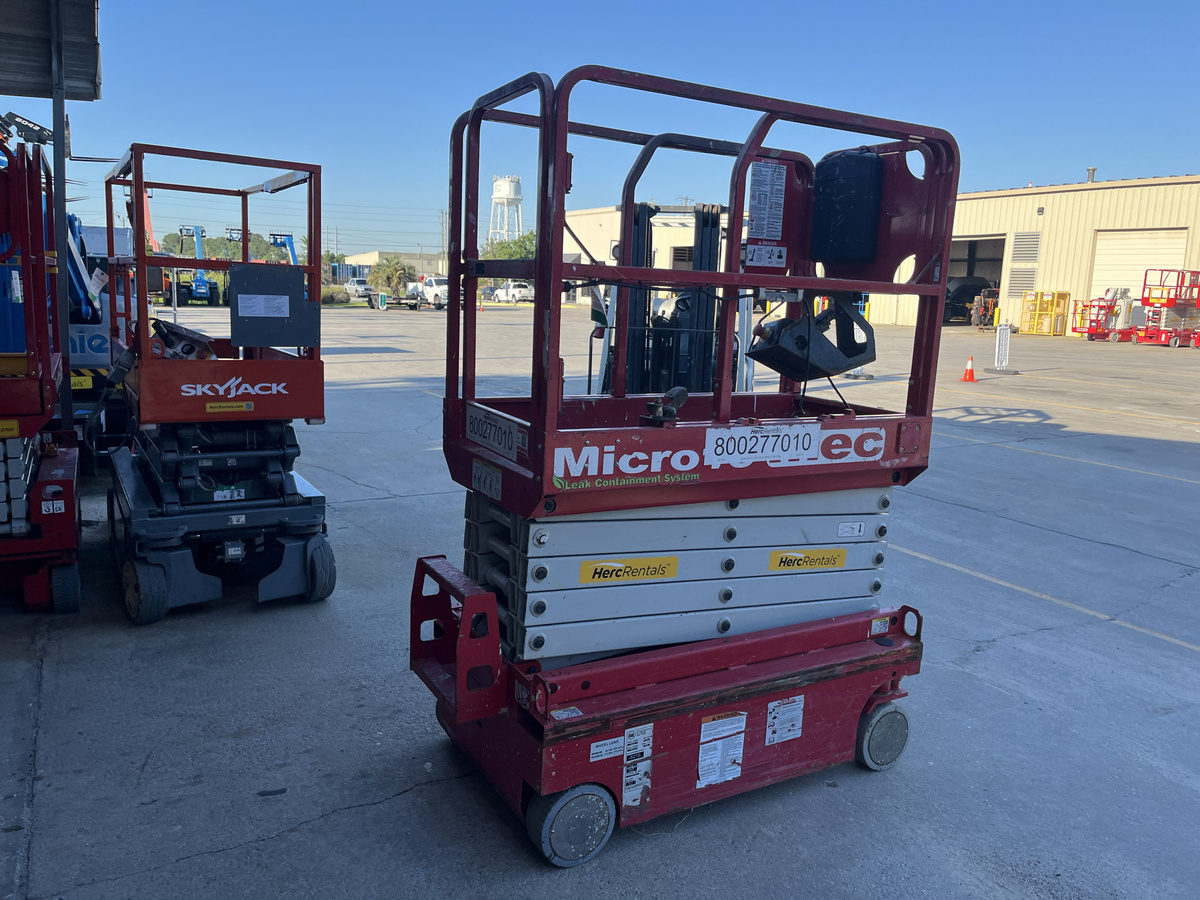
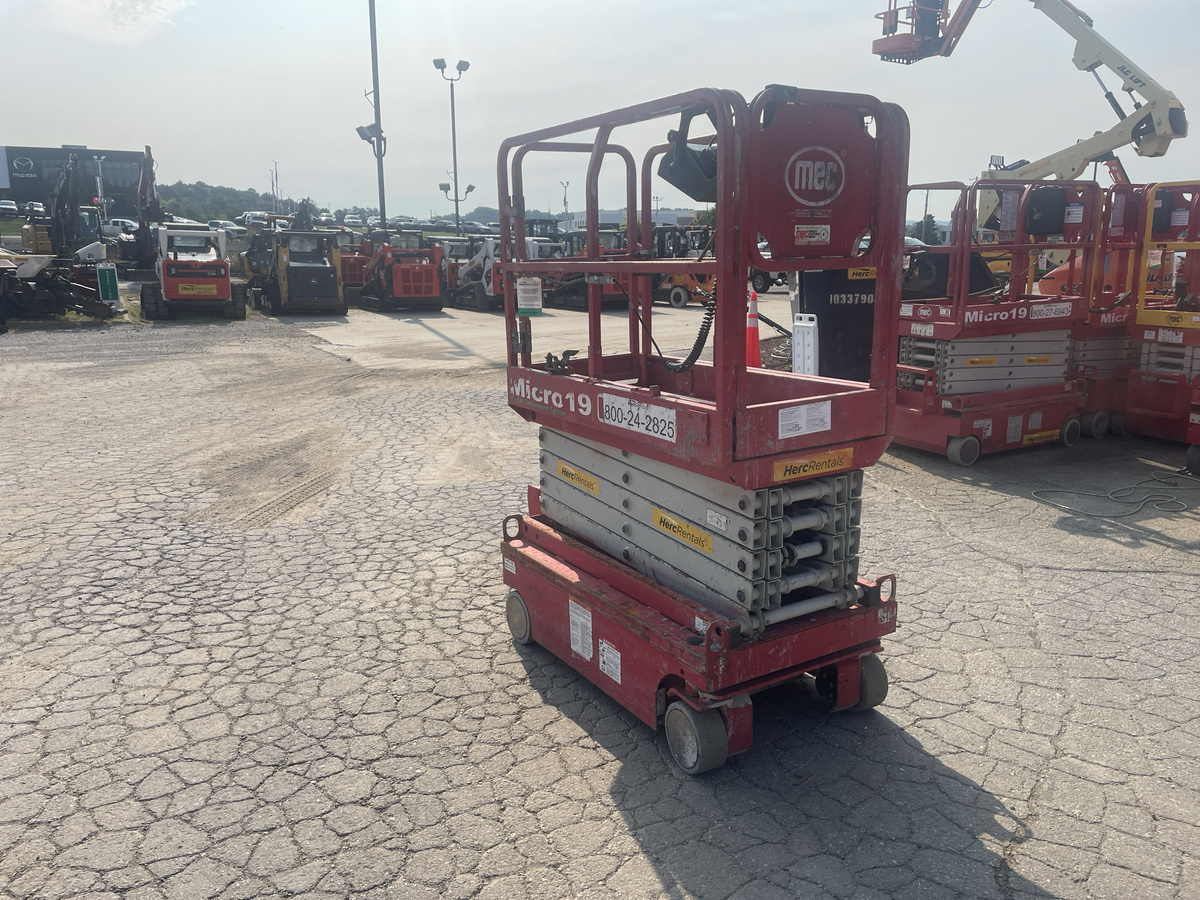
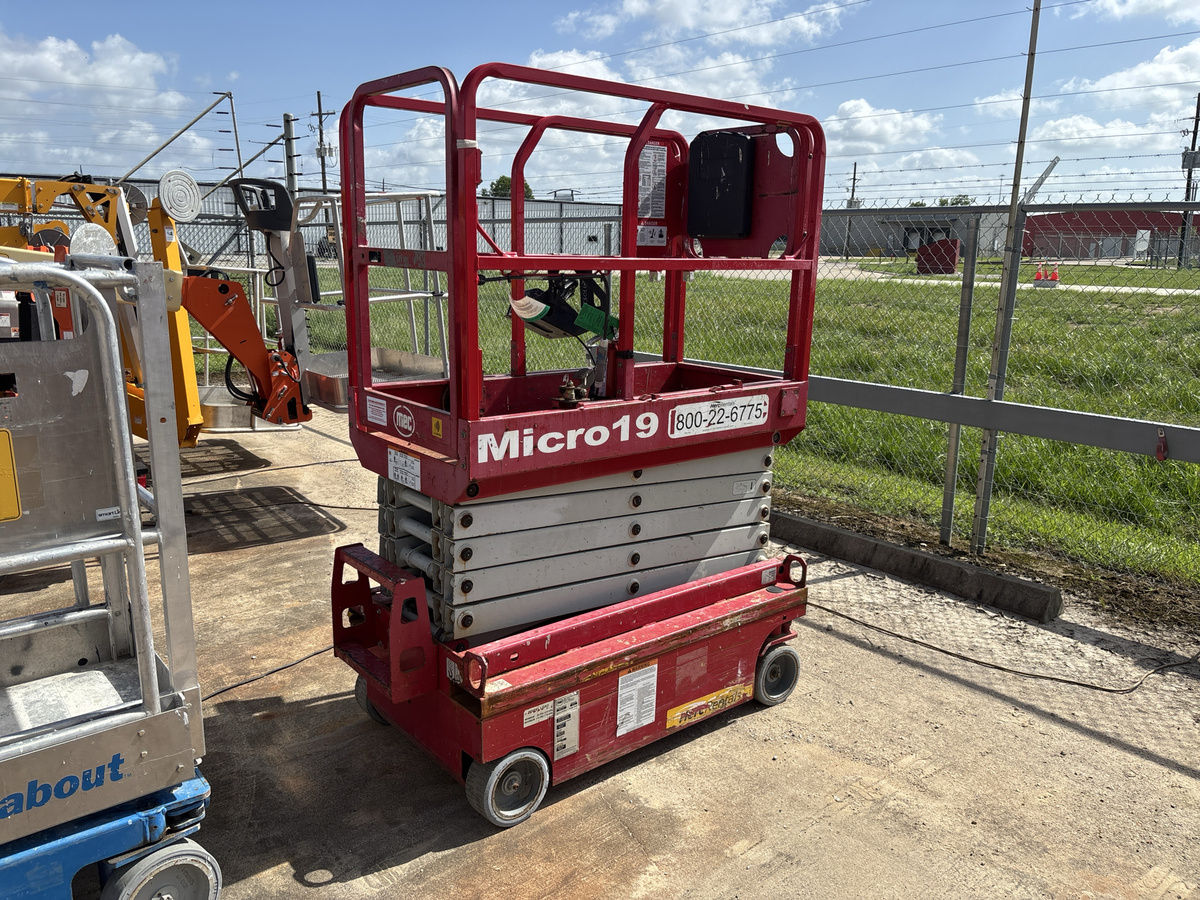
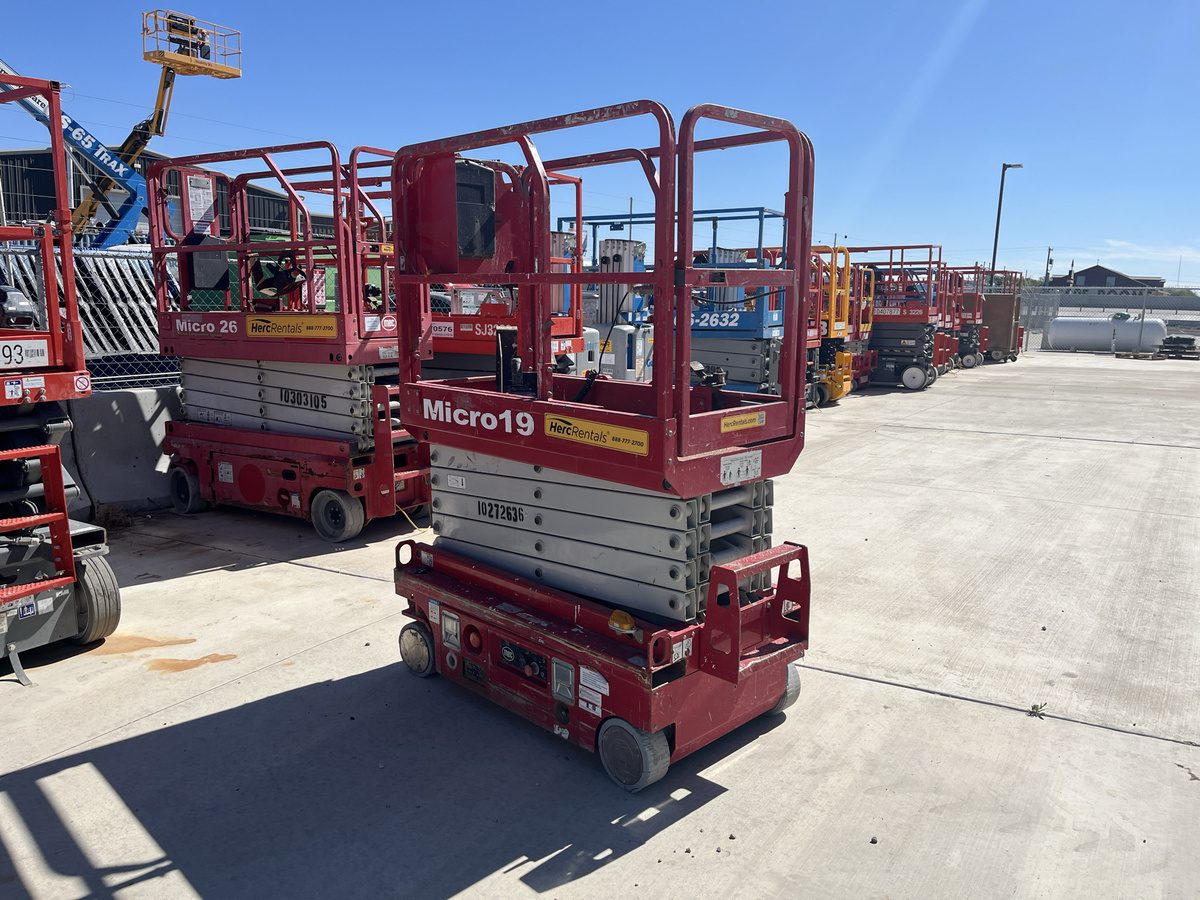
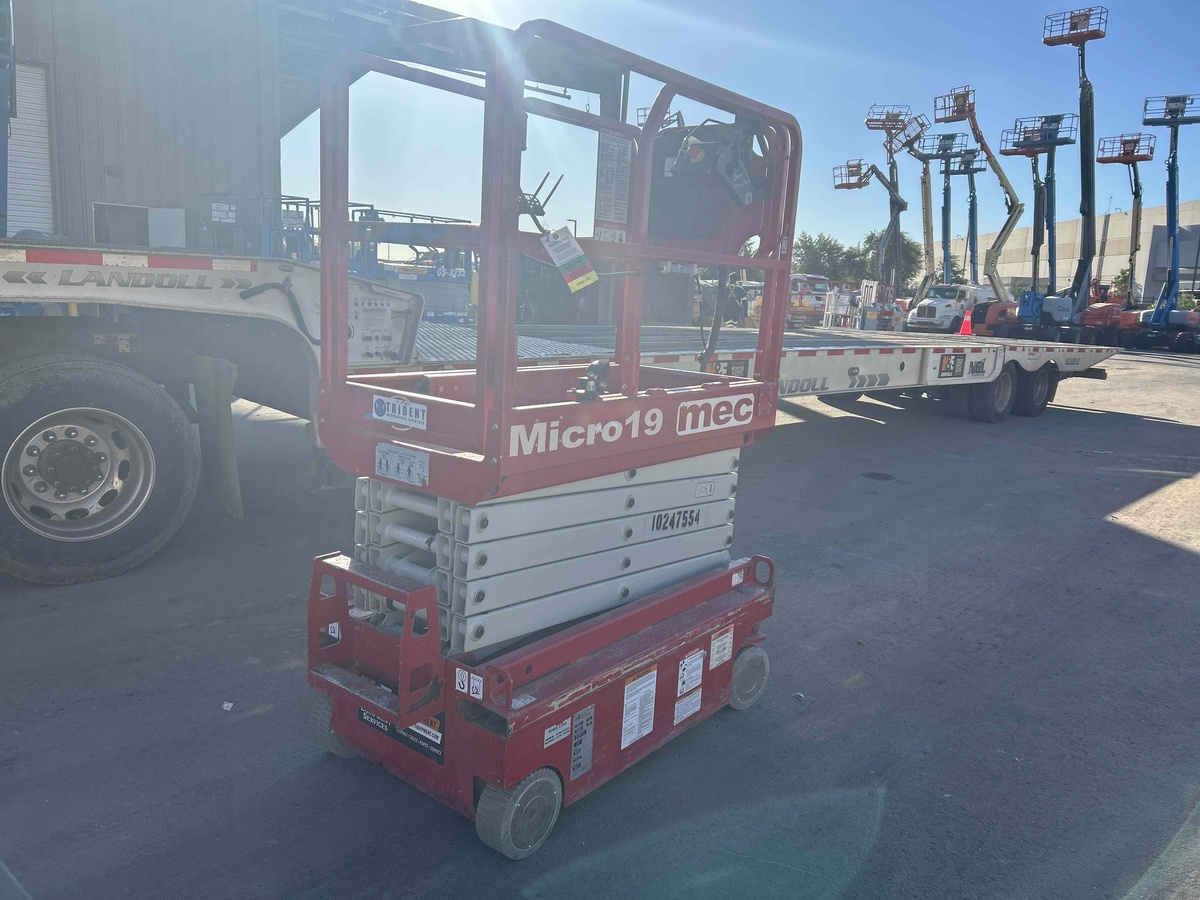
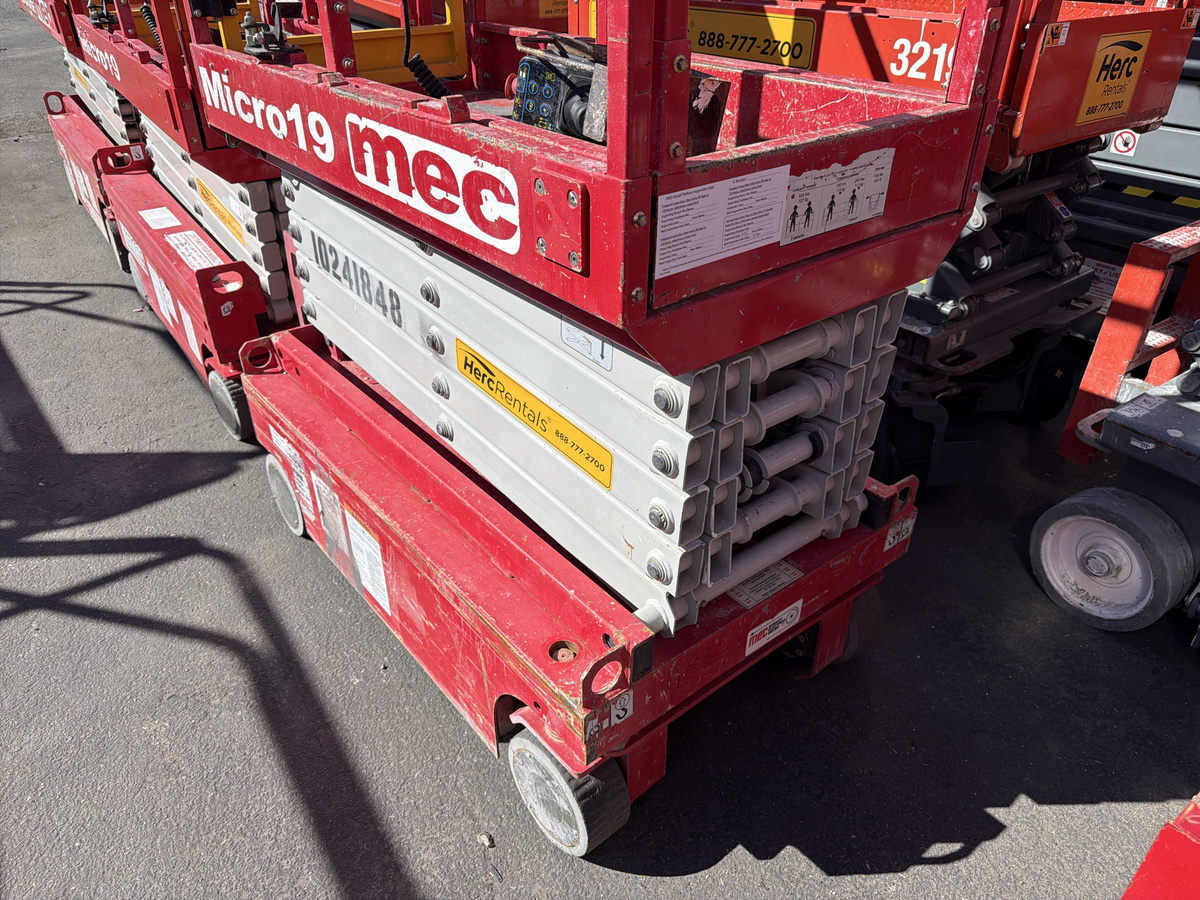
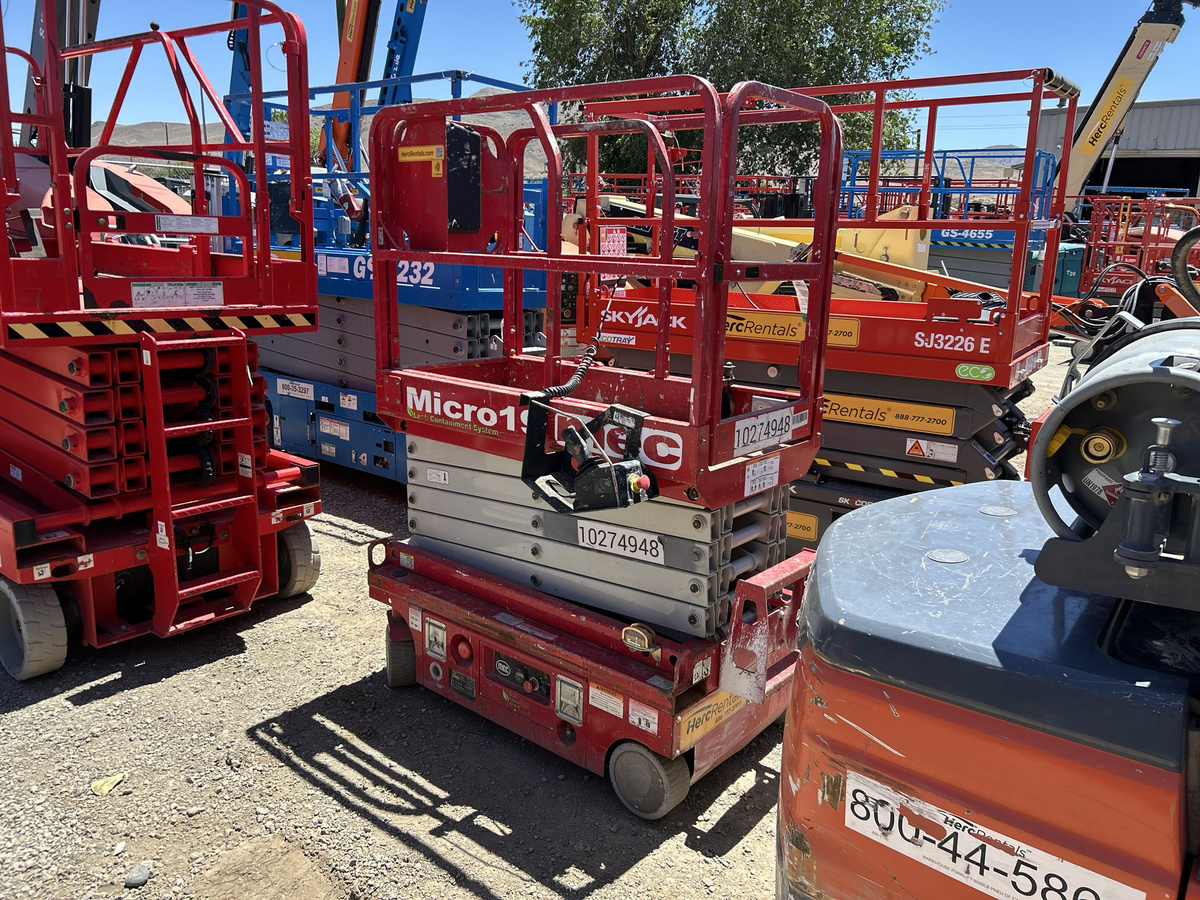

MEC Micro19 Scissor Lift Overview
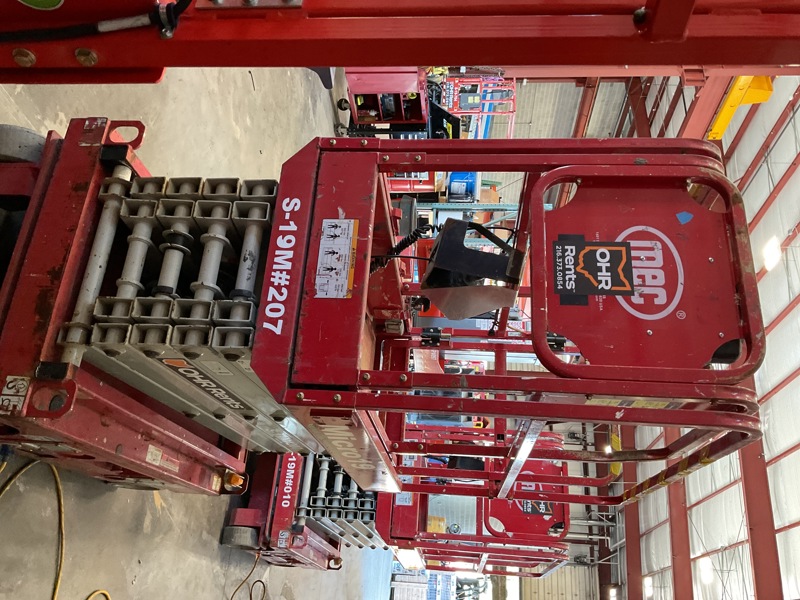
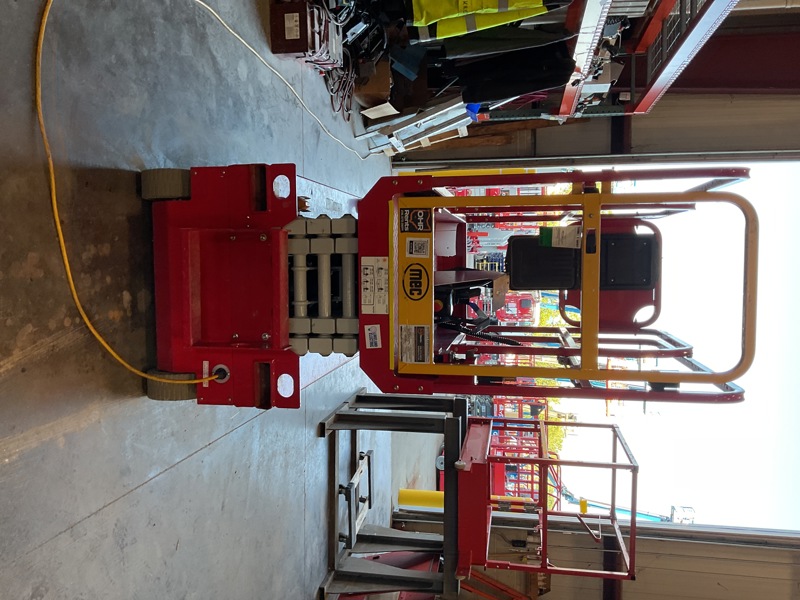
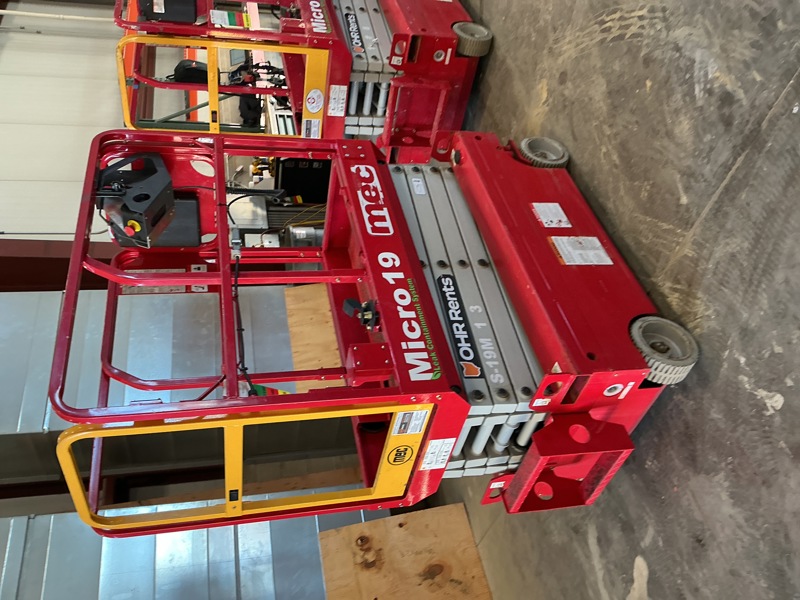
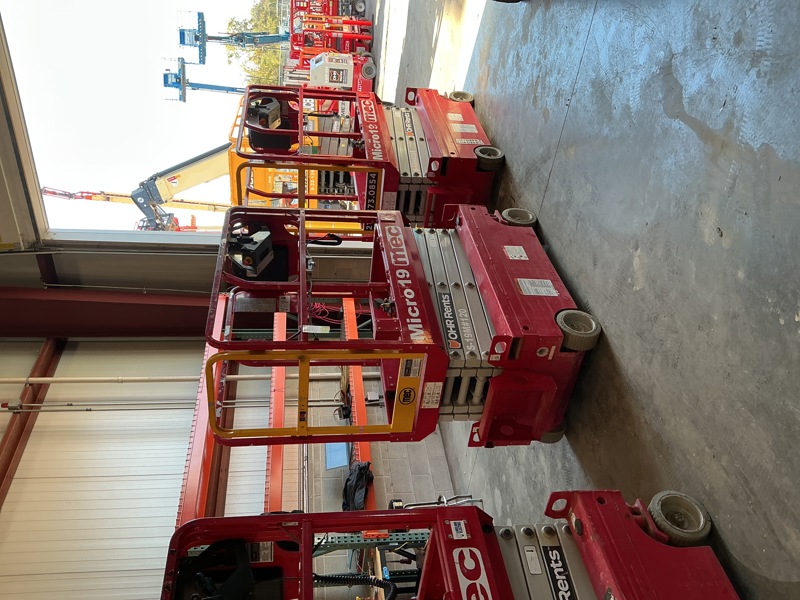
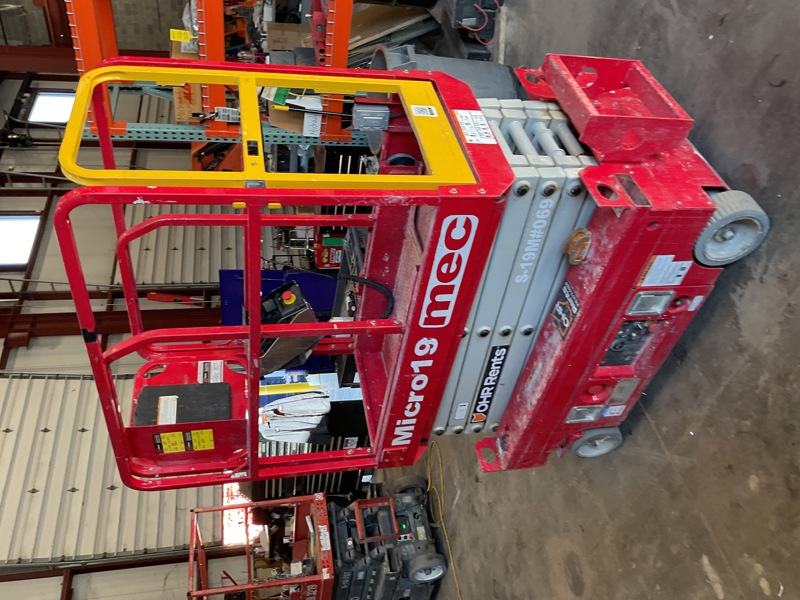
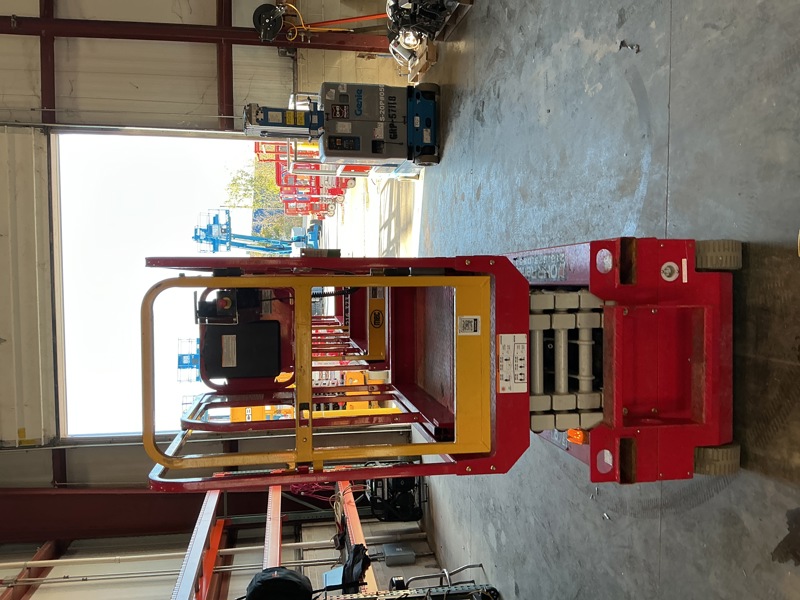
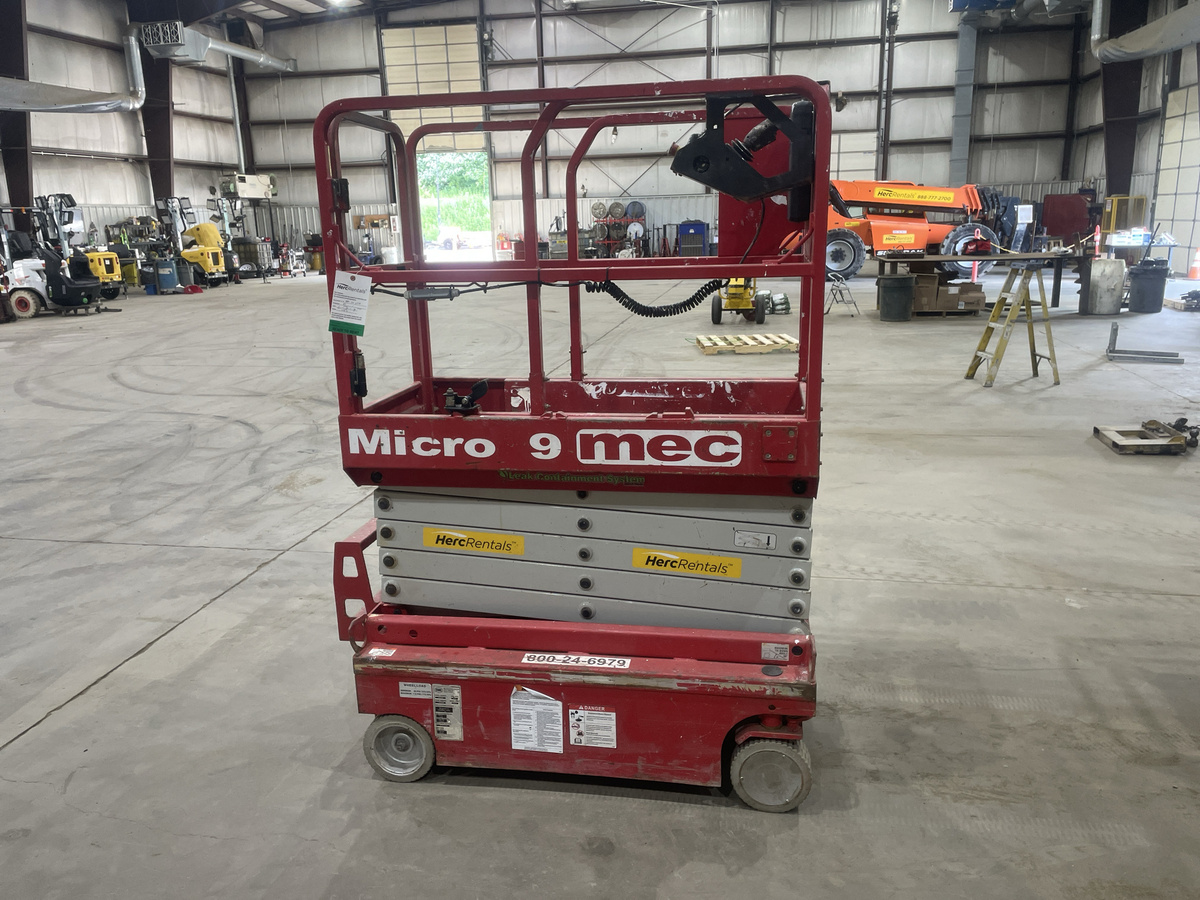
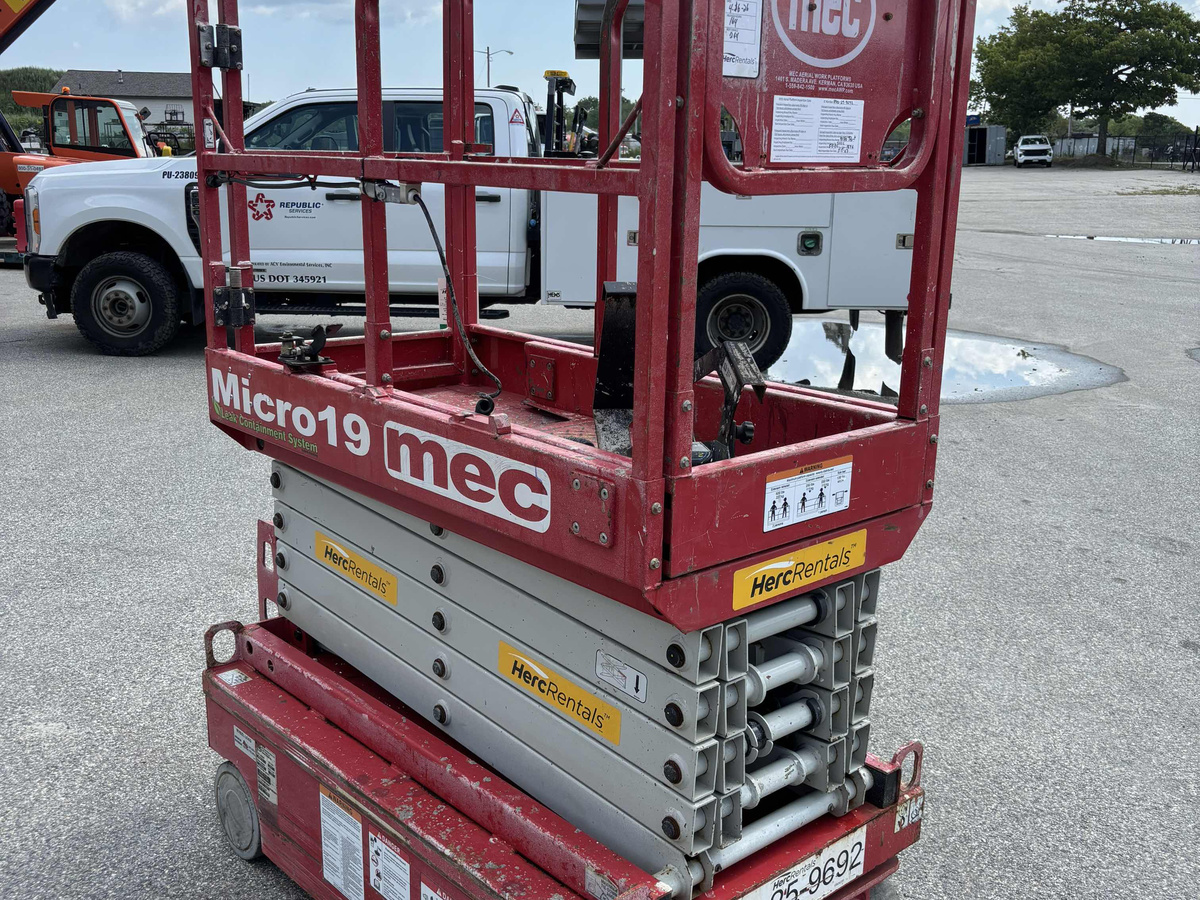
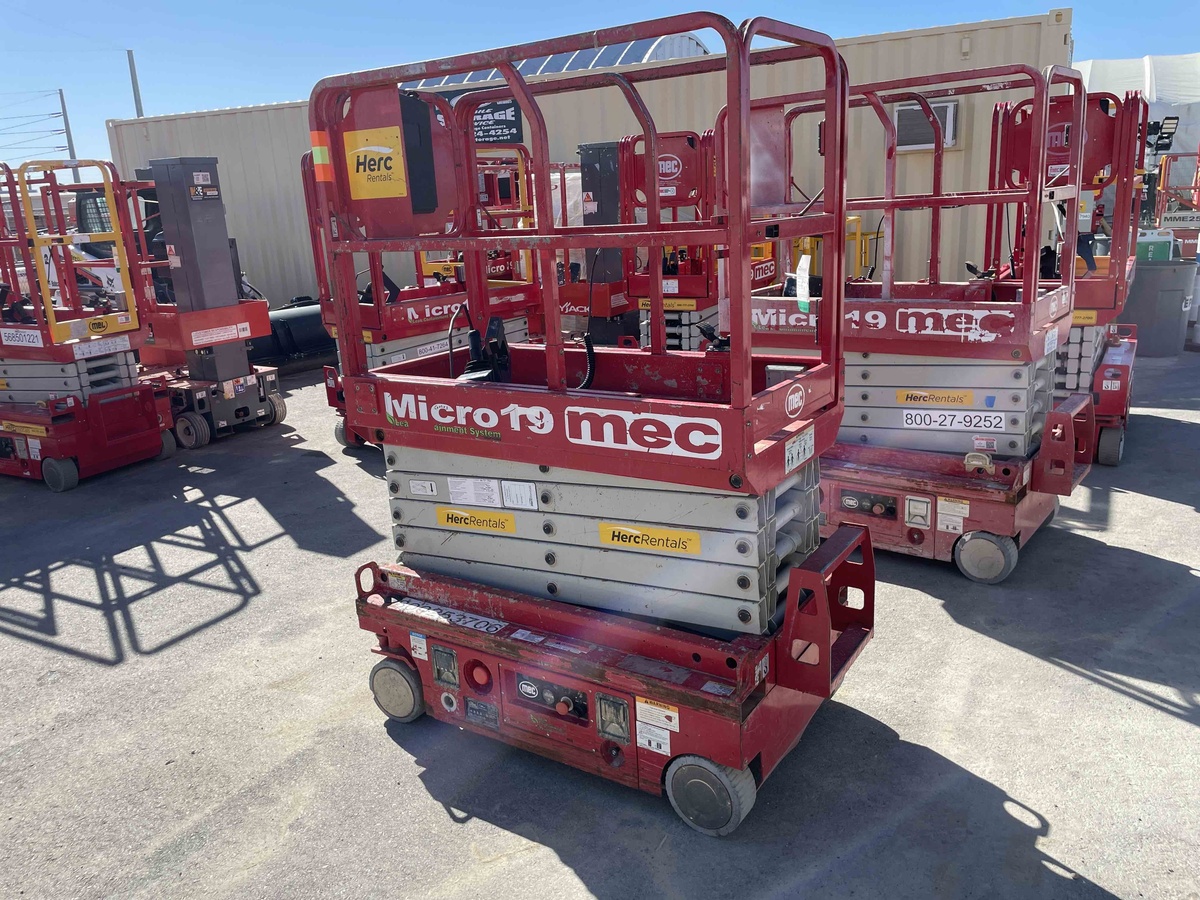
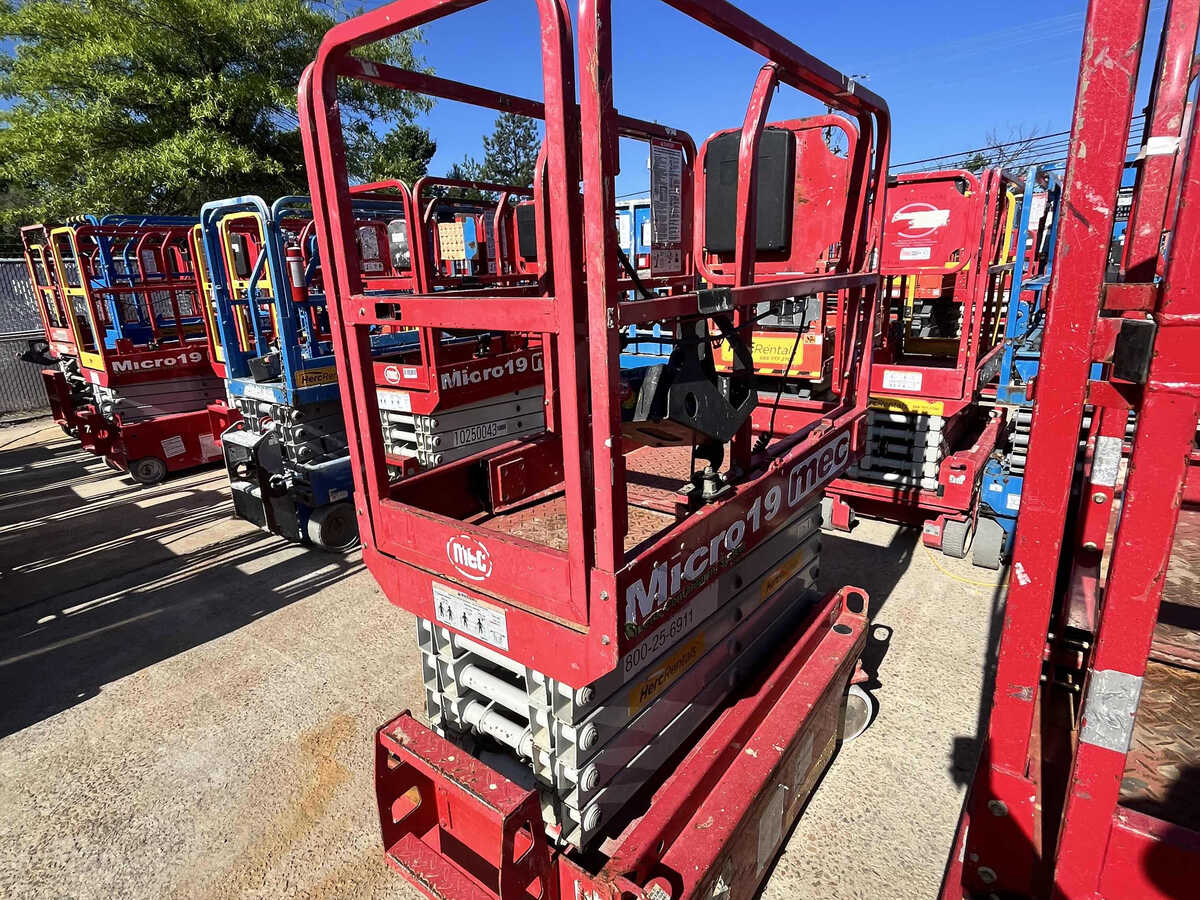
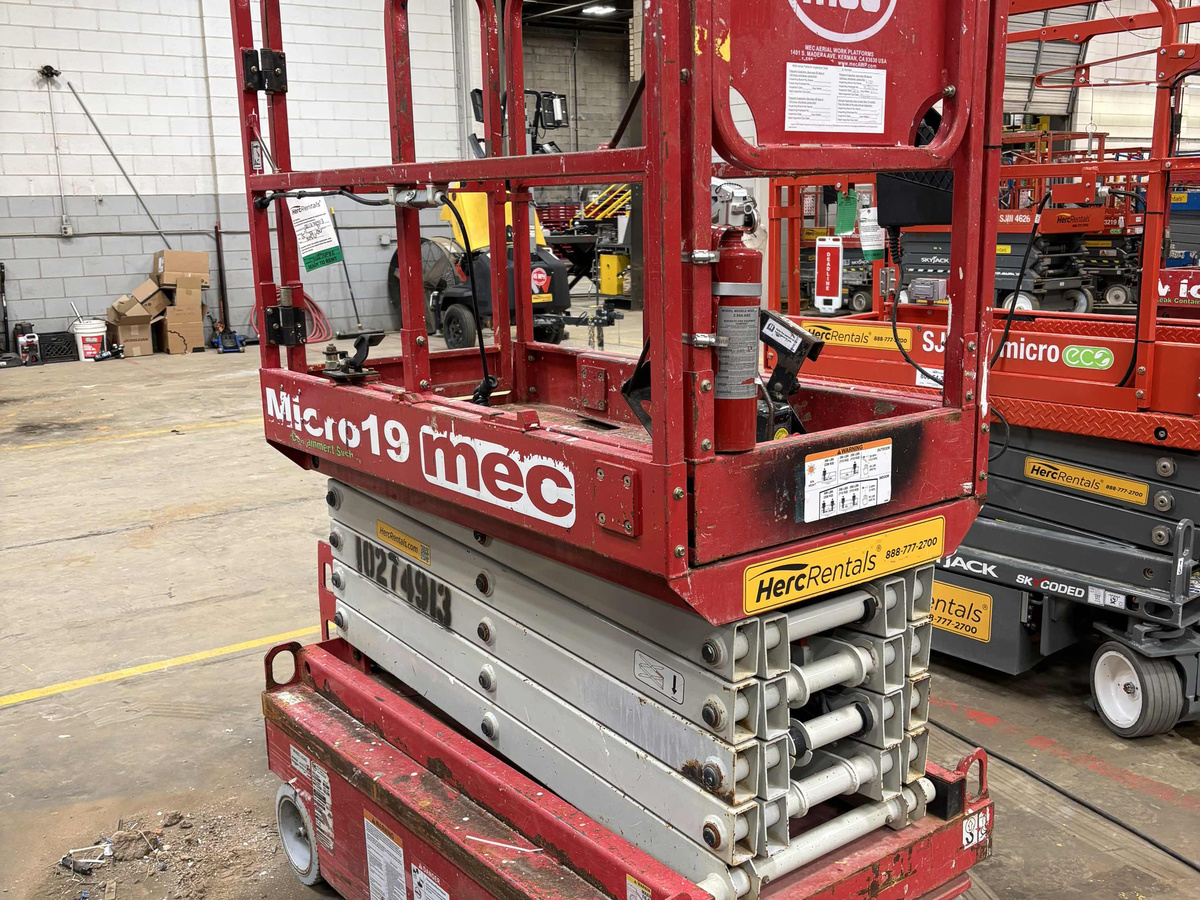
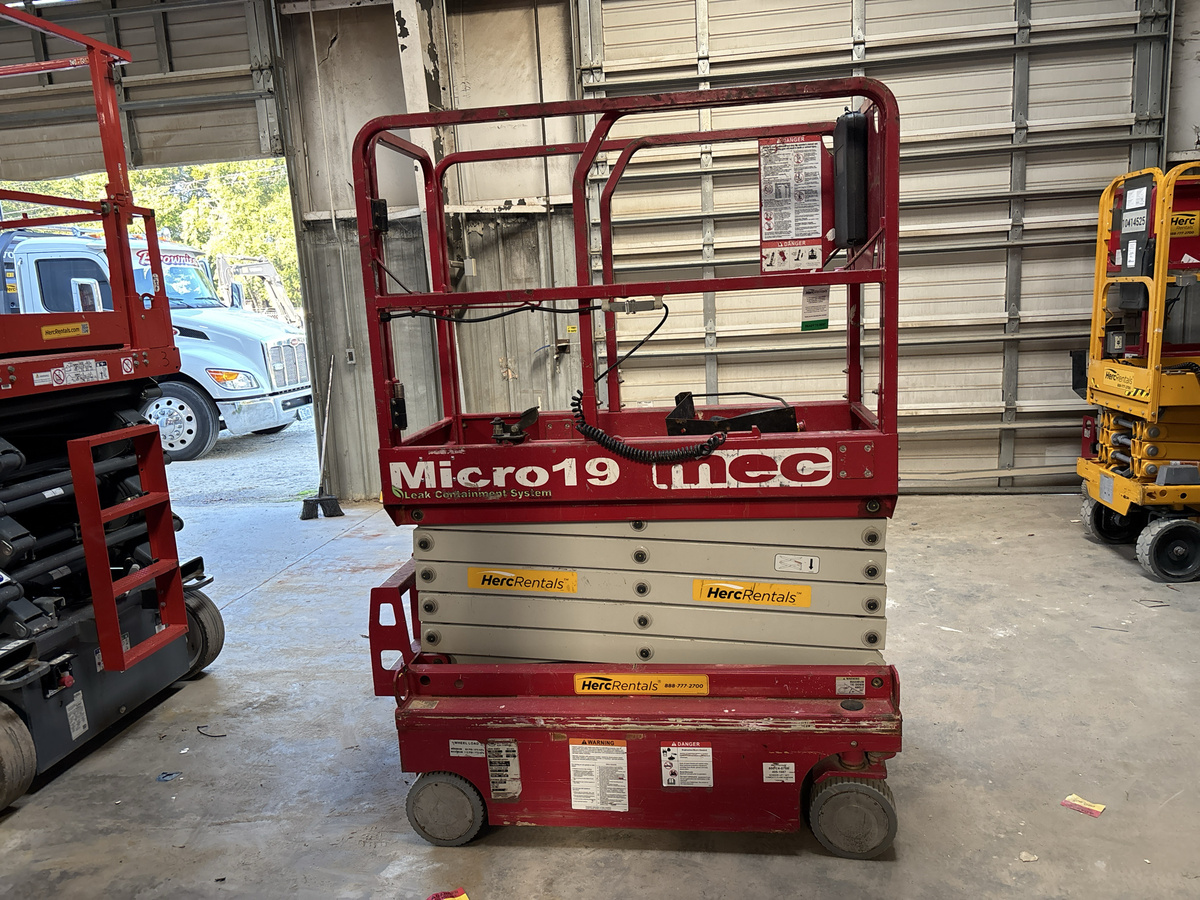
The MEC Micro19 is a compact electric slab scissor lift with a 19 ft class platform (18 ft 4 in actual) and a 24 ft 4 in working height. It carries 500 lb, is 32 in wide and weighs about 2,750 lb, so it fits through standard doorways and onto many freight elevators. Contractors and facility crews use it for electrical, HVAC, sprinkler, ceiling and fixture work in finished buildings. It sits above the smaller MEC 1330SE and below the MEC Micro26, and it competes with the Genie GS-1930, JLG 1930ES and Skyjack SJ3219.
MEC Micro19 Key Features
- Compact footprint: 32 in wide, 60 in long with the ladder and 79 in tall, with a 17.7 in inside turning radius.
- Two people indoors: 500 lb capacity with 2 occupants inside and 1 outside, plus a 24 in roll-out deck rated for 250 lb.
- Direct electric drive: DC drive motors at the wheels instead of hydraulic drive motors, with sealed AGM batteries that need no watering.
- Drives at full height: 2.5 mph stowed and 0.5 mph raised, with 25% gradeability.
- Safety systems: active pothole protection, tilt and overload sensing, descent and motion alarms, automatic parking brakes and a self-closing gate.
- Low maintenance: lube-free scissor bearings, a leak containment system and onboard diagnostics.

MEC Micro19 Specs
Height and Capacity
Size and Platform
Drive and Power
Specs are from MEC’s current Micro19 spec sheet and operator’s manual (ANSI A92.20). MEC’s product page lists 2,860 lb, while the spec sheet and manual list 2,750 lb. Units built before MEC’s 2021 update had folding guardrails and a different overall height, so check the serial plate and decals on any used unit.
Micro19, Micro19-XD and Micro19+
- Micro19: the standard model described above, made since 2017.
- Micro19-XD: adds MEC’s Xtra-Deck, a step-up deck about 20 in above the main platform for one worker (250 lb). It weighs about 2,820 lb, and outdoors it is limited to a 13 ft platform height.
- Micro19+ (2026): MEC’s new PLUS version with AC brushless front-wheel drive, 600 lb capacity, a 300 lb extension deck, 30% gradeability and an 8 in inside turning radius. It weighs about 2,995 lb and is limited to 13 ft outdoors.
What to Check Before Buying a Used MEC Micro19
- Serial plate and decals: confirm the year, capacity and indoor and outdoor ratings.
- Inspection records: ask for the last annual inspection and repair history.
- Batteries and charger: check battery age, look for corrosion, and run the lift through a full charge.
- Fault codes: check the controller display for stored codes before you buy.
- Pothole guards: raise the platform and make sure both guards deploy fully.
- Safety systems: test the tilt alarm, overload sensing, emergency stops and emergency lowering.
- Scissor stack: look for bent arms, cracked welds, worn pins and wobble when raised.
- Hydraulics: check the lift cylinder and hoses for leaks and platform drift.
- Deck and gate: the roll-out deck should slide and lock, and the gate should close on its own.
- Tires and brakes: look for chunked tires, and make sure the brakes hold on a slope.
Document the unit’s condition with the free FleetNow equipment inspection app. Our guides to buying a used scissor lift and electric scissor lift problems cover more.
More MEC and Scissor Lift Options
Browse all used MEC scissor lifts, MEC slab scissor lifts or all MEC equipment, or compare all used slab scissor lifts. Similar models include the MEC Micro19-XD, MEC 1930SE, Genie GS-1930, JLG 1930ES and Skyjack SJ3219. For more 19 ft options, see our used 19 ft scissor lift guide.
Can’t find the right unit? Contact FleetNow or call 1-216-973-5124. Selling a Micro19? List your equipment on FleetNow.
MEC Micro19 Troubleshooting
The Micro19 shows fault codes on its controller display. Start with these checks, and use the MEC operator’s and service manuals for your serial number. Leave repairs to a qualified technician.
1. Lift Will Not Lower (Power Failure):
- Use the emergency lowering knob near the base control panel to bring the platform down.
- The descent alarm does not sound during emergency lowering, so make sure the area below is clear.
2. Tilt Alarm or LL Code:
- LL means the machine is not level. Lower the platform, move to level ground and reset the emergency stop.
- If LL stays on or code 32 appears, have the tilt sensor wiring checked and the sensor recalibrated.
3. Pothole Guard Fault (Code 18):
- Check that nothing blocks the pothole bars and that both bars deploy fully when the platform rises.
- Inspect the pothole limit switches in the wheel wells.
4. Platform Will Not Lift (OL Code):
- OL means the platform is overloaded. Remove weight until the load is under 500 lb, including the extension deck limit.
- Codes 80, 90 and 99 are warnings at 80, 90 and 99 percent of capacity. Code 31 or H9 means the load sensing needs calibration.
5. Battery and Charger Faults:
- Codes 36 and 68 mean low battery voltage. Check the connections, charge fully and load-test the batteries.
- If the charger alarm sounds, check the charger fuse and battery connections, and use an extension cord of 50 ft or less.
6. Other Codes:
- Codes 02 and 20 point to a communication fault between the control box and controller. Check the cable and connectors.
- Code 12 means a chassis switch was held at startup. CH on the display is not a fault, it means base controls are selected.
Recent Equipment News
MEC MME25 Review: Specs, Features & Industry Perspective
MEC MME25 Review: Specs, Features & Industry [...]

Construction Equipment Trends 2025: Inside Q1–Q2 Demand & What It Means for You
Table of Contents Top 10 Categories Q1 vs [...]

Pettibone AS1932E Review: Specs, Price, Pros & Cons
Pettibone AS1932E Review: Specs, Price, Pros & Cons [...]