
How to Buy a Used Towable Boom Lift: Prices, Sizes & Top Models
Last updated: October 19, 2026
Thinking about buying a used towable boom lift? These compact, versatile machines tow behind a pickup and reach 34 to 50 ft or more, without the cost of a new unit. But buying used requires extra care: you want a reliable machine that’s safe, job-ready and priced right.
This guide covers what to look for, popular models and sizes, what you can expect to pay, and what you need to tow one safely.
Table of Contents
Towable Boom Lifts: Applications, Advantages and Considerations
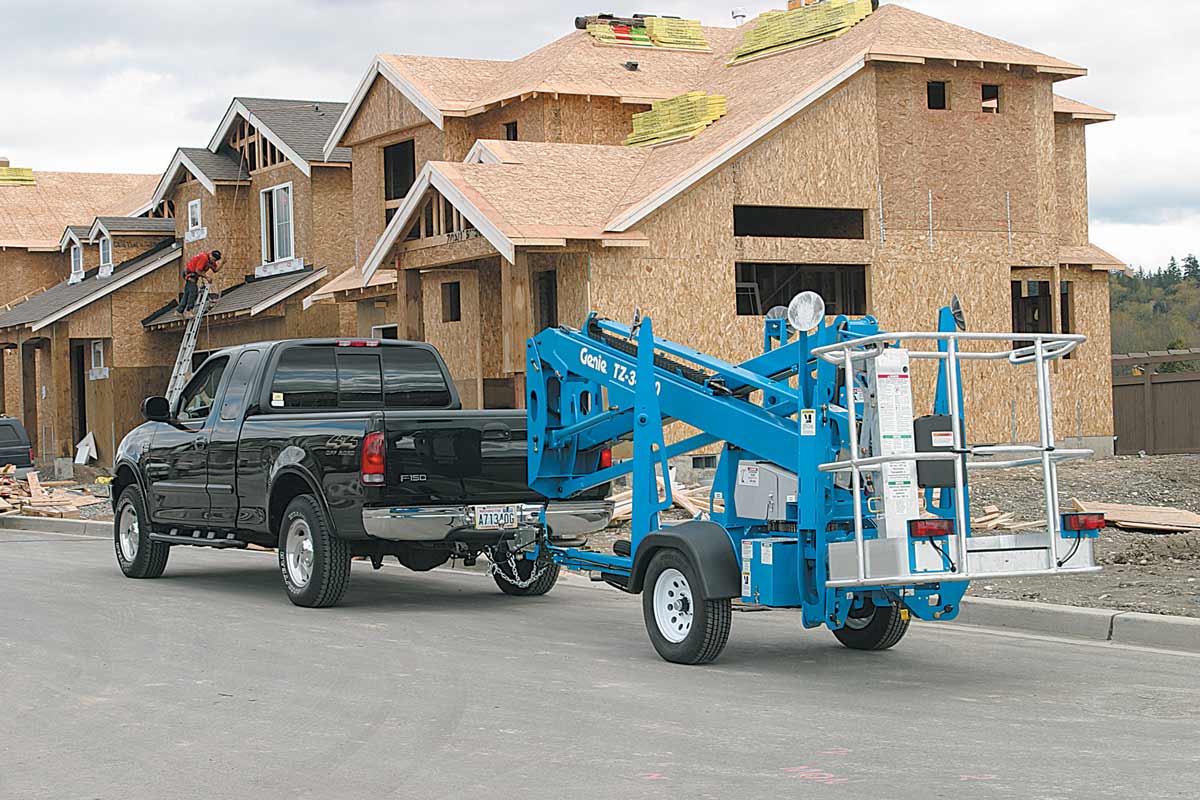
Towable boom lifts, also called trailer lifts or tow-behind lifts, are compact, transportable aerial work platforms built for mobility, flexibility, and efficiency. Unlike self-propelled lifts, they can be towed by standard vehicles, making them ideal for contractors, service providers, and maintenance teams that move frequently between job sites.
These lifts combine compact transport with substantial reach, allowing teams to access elevated areas safely and efficiently — without requiring heavy-duty vehicles or permanent storage.
Key Applications for Towable Boom Lifts
Towable boom lifts are widely used in industries where height access and portability are critical:
- Construction & Renovation: Exterior repairs, siding, windows, and façade work
- Electrical & Utility Work: Servicing power lines, streetlights, and communications infrastructure
- Signage & Facility Maintenance: Installing or servicing signs, lighting, and building exteriors
- Landscaping & Tree Care: Pruning, trimming, and maintaining trees or hedges
- Industrial & Event Setup: Accessing elevated storage racks, stages, or temporary structures
Advantages of Towable Boom Lifts
Experienced operators value towable lifts for their combination of performance, portability, and cost-effectiveness:
- Portable & Towable: Easy transport with a properly rated pickup, no separate transport trailer needed
- Compact Footprint: Maneuverable in tight or restricted jobsite spaces
- Cost-Effective: Lower upfront and operating costs compared to self-propelled lifts, especially when buying used
- Quick Deployment: Set up and ready to operate in minutes
Towable vs. Non-Towable Boom Lifts: What Is the Difference?
When deciding on a boom lift for your job site, understanding the key differences between towable (trailer-mounted) and non-towable (self-propelled) lifts is critical. Each has distinct advantages depending on mobility needs, site conditions, and budget.
| Feature | Towable Boom Lift | Non-Towable / Self-Propelled Boom Lift |
|---|---|---|
| Mobility | Can be towed with a standard pickup or van between sites | Requires a dedicated truck or transport trailer for relocation |
| Setup Time | Quick deployment; minimal setup | Often more complex setup and transport logistics |
| Weight & Ground Pressure | Lightweight, low PSI ideal for sensitive surfaces | Heavier, higher ground pressure, can damage turf or pavement |
| Platform Reach | Platform heights of about 34–50 ft on the most common models | Wider range of heights (up to 100+ ft) |
| Cost | Lower purchase and maintenance costs | Higher upfront and ongoing costs |
| Job Site Versatility | Great for tight spaces, temporary sites, landscaping, rooftop work | Best for large construction sites, industrial projects, and heavy-duty applications |
| Transportation Convenience | Tow behind standard vehicle; minimal extra transport fees | Requires specialized equipment or trailers; additional costs |
| Maintenance | Generally simpler and more cost-effective | More complex hydraulic and drive systems; higher maintenance requirements |
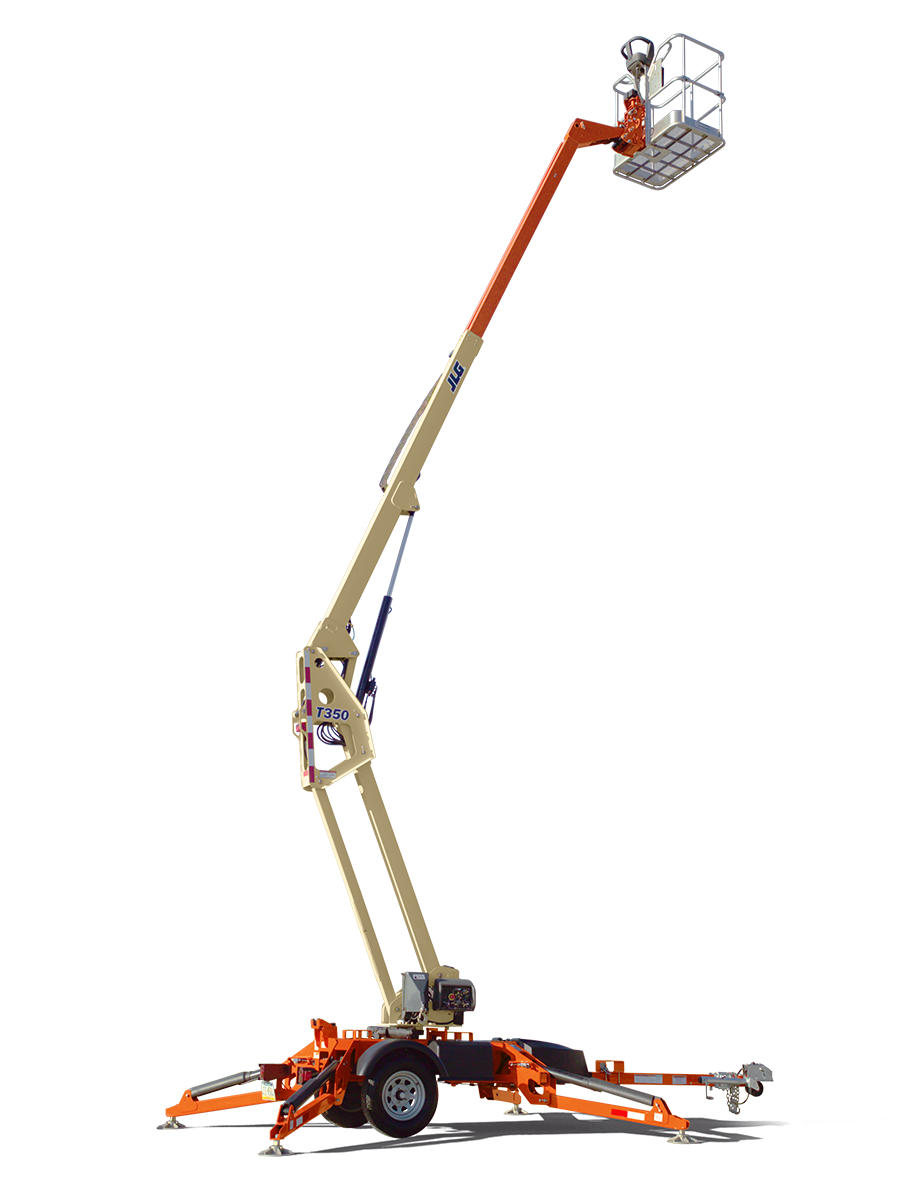
JLG T350 Towable Boom
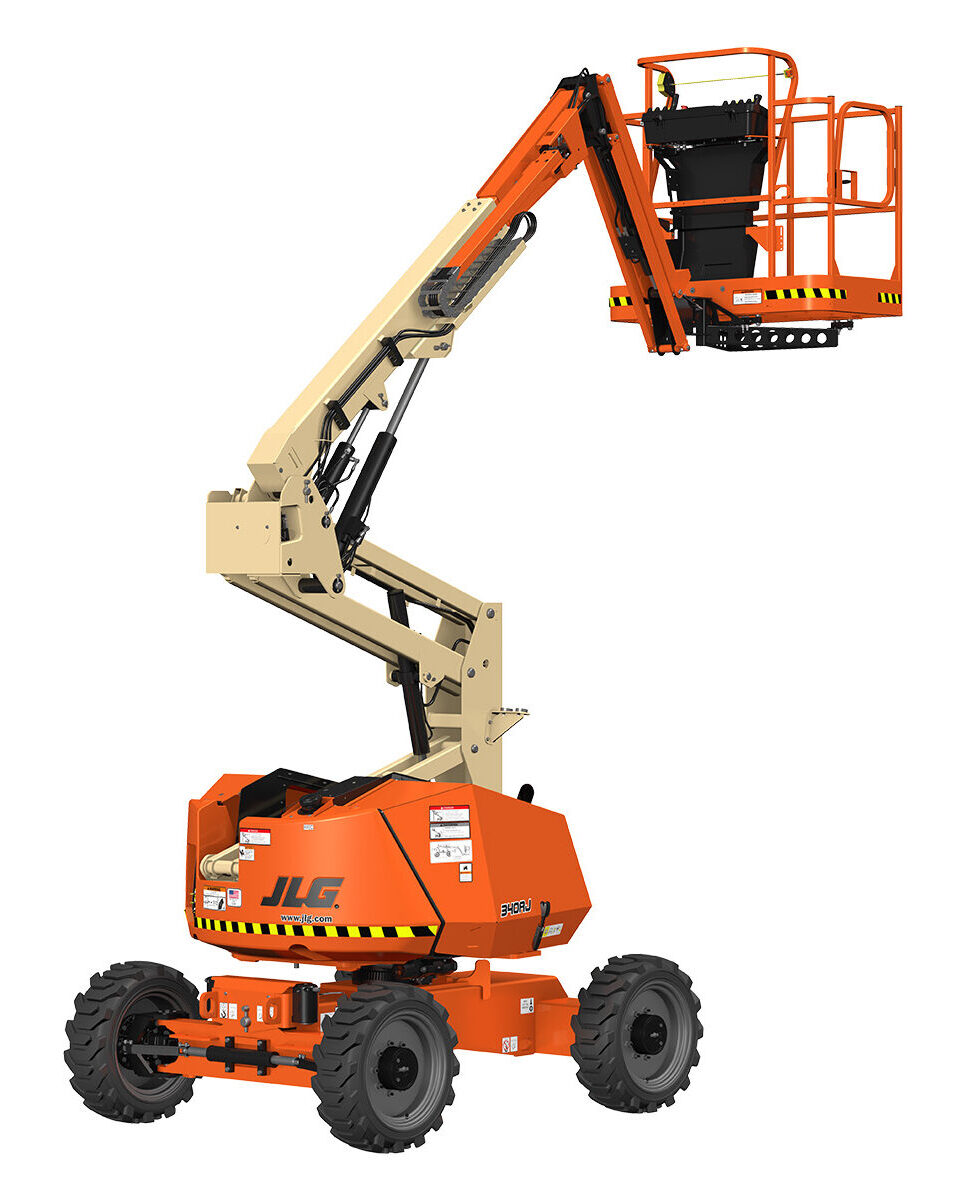
JLG 340AJ Non-Towable Boom
What Should I Look for When Buying a Used Towable Boom Lift?
Beyond choosing the right size lift for your project, there are several other factors to keep in mind:
- Year, hours, and condition: Consider the lift’s year, total hours, and overall condition. Inspection reports from the seller can help confirm this information.
- Maintenance and inspection history: If you’re buying from a rental yard or equipment dealer, ask to see inspection reports. These show regular maintenance, past repairs, and any issues the lift has had.
- Helpful features: Look for auto-leveling outriggers, which speed up setup on uneven ground, and optional drive systems (offered on some models) that let you move the lift around the job site without a vehicle.
- Annual inspection: ANSI A92 standards require a documented annual inspection by a qualified technician. Ask for the most recent one, and check that any open manufacturer safety bulletins have been completed.
- Towing components: Check the coupler, safety chains, lights, tires and brakes (if equipped), since these wear on the road as well as on the job.
Paying attention to these factors can help you avoid costly repairs and ensure the lift performs reliably on the job.
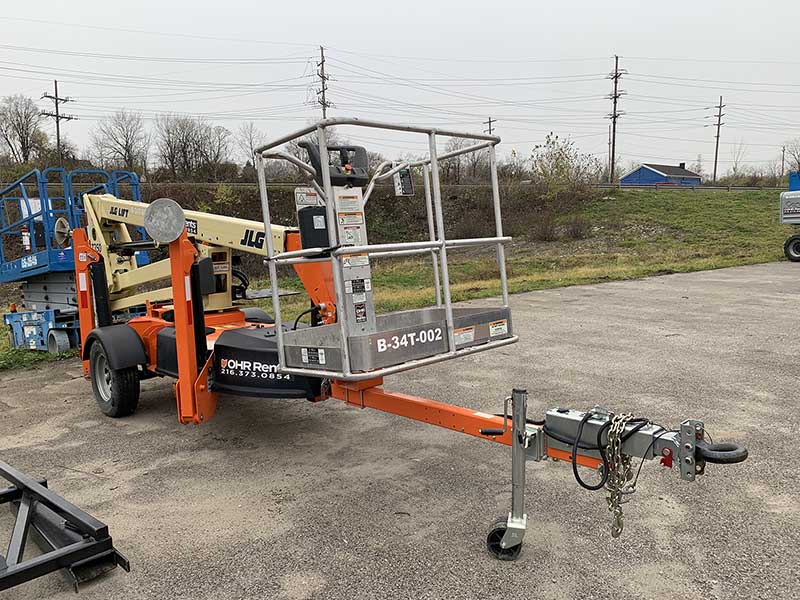
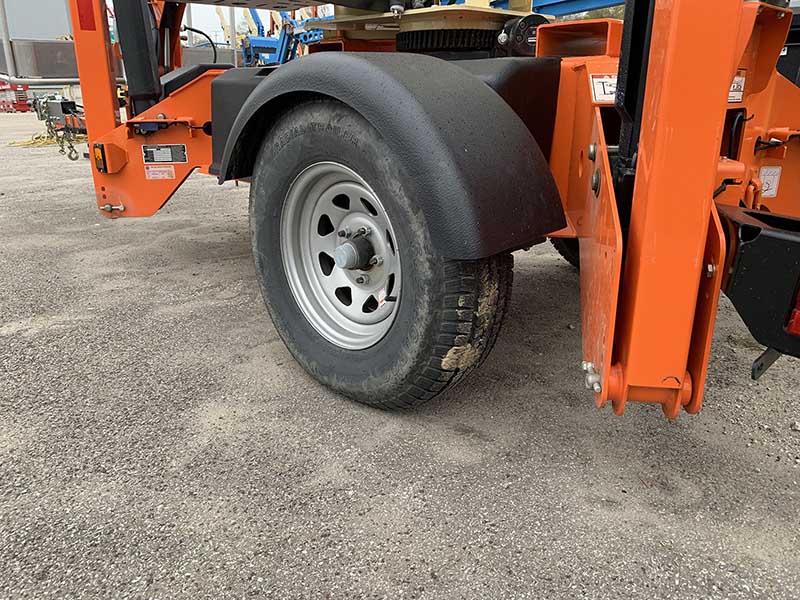
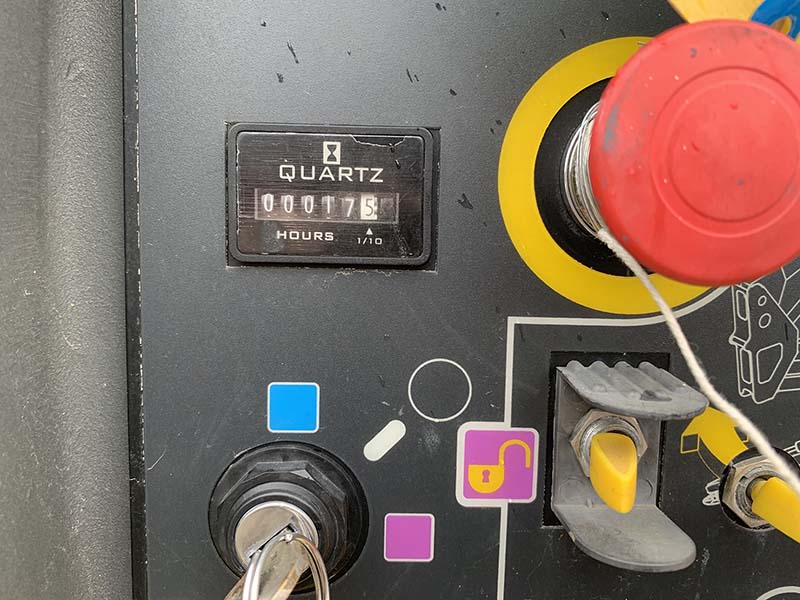
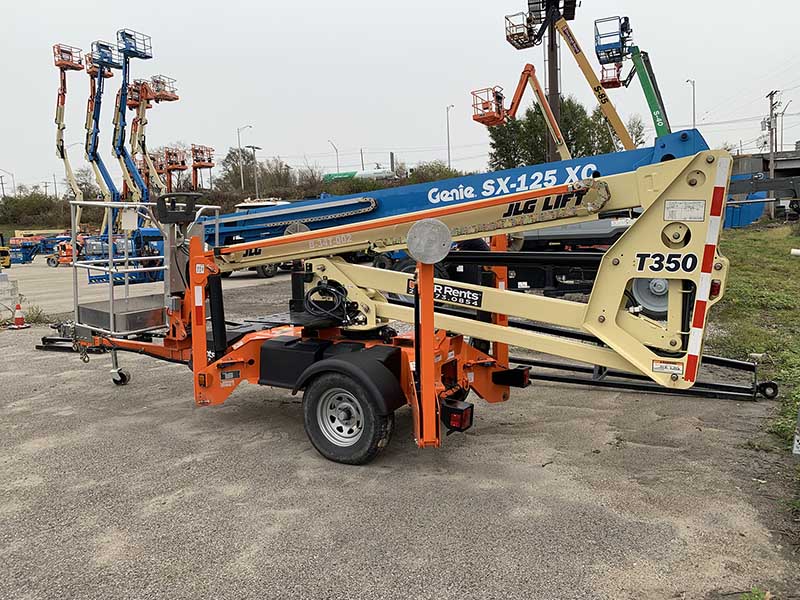
Note: It’s entirely acceptable to ask for detailed photos of all 4 tires, control panel, meter, motor, and of any damage to the lift you’re thinking about buying. Don’t forget to compare the meter readings in the photo to the meter reading advertised. Here are some examples of photos you should expect to receive:
What Sizes Are Available for Used Towable Boom Lifts?
The size of a towable boom lift is typically described by its maximum platform height or working height. Here’s a general guide:
- 30–35 Feet: Ideal for smaller tasks, such as residential work or light commercial projects.
- 40–50 Feet: A versatile range for commercial applications, including building maintenance, tree trimming, and general construction.
- 50–70 Feet: Suited for more demanding jobs that require extended reach, like taller building maintenance or advanced construction projects.
While working height indicates how high the platform can extend, horizontal reach can vary by model. Some lifts feature a jib or articulating arm for added flexibility, making it easier to reach tricky spots.
When evaluating a lift, also consider:
- Lift capacity – the weight it can safely handle
- Stabilization options – outriggers or leveling features
- Additional features – self-propelled movement, self-leveling, or other job-specific capabilities
Choosing the right size and features ensures the lift can safely and efficiently handle the tasks you need it for.
Popular Used Towable Boom Lift Models
These are the towable boom lifts you’ll see most often on the used market:
| Model | Platform Height | Horizontal Outreach | Capacity | Weight | Jib |
|---|---|---|---|---|---|
| Genie TZ-34/20 | 34 ft | 18 ft 4 in | 500 lb | 3,155 lb | No |
| JLG T350 | 34 ft 6 in | 18 ft 9 in | 500 lb | 3,600 lb | No |
| Snorkel TL37J | 35 ft 9 in | 18 ft 5 in | 475 lb | 3,498 lb | Yes |
| Niftylift TM34T | 33 ft 6 in | 20 ft | 440 lb | About 3,110 lb | No |
| Genie TZ-50 | 49 ft 6 in | 29 ft 2 in | 500 lb | 4,400 lb | No |
| JLG T500J | 50 ft | 30 ft | 500 lb | 4,800 lb | Yes |
How Much Do Used Towable Boom Lifts Cost?
Used towable boom lift prices depend mostly on size, year, hours, power type and condition. Here’s what common models are listed for on FleetNow:
| Size Class | Example Models | Used (FleetNow Asking) | New (Dealer Asking) |
|---|---|---|---|
| 34–35 ft platform | JLG T350, Genie TZ-34/20 | About $16,800–$24,900 (2009–2019 models) | About $36,000–$42,500 |
| 50 ft platform | Genie TZ-50, JLG T500J | About $24,600–$32,950 (2016–2019 models) | About $54,000 and up |
Prices are FleetNow asking prices as of October 2026 and change daily. Low-hour, late-model and electric units sit at the top of each range. Browse used towable boom lifts for sale.
What Vehicle Do I Need to Tow a Towable Boom Lift?
Towable boom lifts are built to be towed behind a pickup, but the right tow vehicle depends on the lift’s size and weight. Always check the lift’s operator’s manual and your vehicle’s towing specifications.
Small to Medium Lifts (34–35 ft platform height)
- Most weigh about 3,100–3,600 lb. The JLG T350 weighs about 3,600 lb, and the Genie TZ-34/20 about 3,155 lb.
- Most full-size pickups and many SUVs with a towing package can handle them. Make sure your vehicle’s towing capacity exceeds the lift’s weight.
Larger Lifts (50 ft platform height)
- These weigh about 4,400–4,800 lb. The Genie TZ-50 weighs about 4,400 lb, and the JLG T500J about 4,800 lb.
- A full-size or heavy-duty pickup with a higher tow rating is the safer choice.
Hitches, Brakes and Road Rules
- Hitch: Match your hitch to the lift’s coupler. The JLG T350 uses a 2-in ball, while Genie TZ models come with a combination coupler that fits a 2-5/16-in ball, clevis or pintle.
- Tow speed: Manufacturers rate these machines for highway towing, up to 60 mph for Genie TZ models and 65 mph for JLG towables.
- Trailer brakes: Many states require trailer brakes above a certain weight, often between 1,500 and 3,000 lb. Most towable boom lifts exceed that, so check that the lift’s brakes work and that it meets your state’s rules.
- Safety: Use safety chains, confirm all trailer lights work, and stow and secure the boom and outriggers before towing.
Here are some common pickup truck models and their towing capacity:
| Make & Model | Max Towing Capacity | Configuration |
|---|---|---|
| Ford F-150 | 14,000 pounds | 3.5-liter EcoBoost V6 |
| Chevrolet Silverado 1500 | 13,300 pounds | 3.0-liter turbodiesel, double cab, 2WD, max trailering package, and 20-inch wheels |
| GMC Sierra 1500 | 13,000 pounds | 3.0-liter turbodiesel, double cab, 4WD, max trailering package, and 20-inch wheels |
| Ram 1500 | 12,750 pounds | 5.7-liter HEMI V8 with eTorque |
| Toyota Tundra | 12,000 pounds | 2WD SR5 with the tow package |
| Nissan Titan | 9,320 pounds | King Cab 4×2 |
How to Tow and Operate a Towable Boom Lift
The video below will show you how to connect / disconnect your towable boom lift to your hitch and how to operate the lift.
Towable Boom Lift FAQs
Most popular towable boom lifts have platform heights of about 34–35 ft (around 40 ft working height). Larger models like the Genie TZ-50 and JLG T500J reach about 50 ft of platform height, or roughly 56 ft working height.
Usually, yes, for 34–35 ft models, which weigh about 3,100–3,600 lb. Larger 50-ft models weigh about 4,400–4,800 lb and are better suited to a full-size or heavy-duty pickup. Always confirm your truck’s tow rating and hitch match the lift.
Many states require trailer brakes above a set weight, often between 1,500 and 3,000 lb, and most towable boom lifts exceed that. Rules vary by state, so check local requirements and make sure the lift’s brakes and lights work before towing.
Yes. ANSI A92 standards require a documented annual inspection by a qualified technician, no more than 13 months after the previous one. Ask for the latest inspection report when buying used.
Electric (DC) models are quiet and emission-free, which suits indoor work and noise-sensitive sites. Gas or bi-energy models can run longer away from a charger. Many popular models, like the JLG T350, are offered in both versions.
As of October 2026, used 34–35 ft towable boom lifts like the JLG T350 and Genie TZ-34/20 are listed on FleetNow for about $16,800–$24,900, and 50-ft models like the Genie TZ-50 and JLG T500J for about $24,600–$32,950. Browse used towable boom lifts.
Because towable lifts are often used by workers unfamiliar with lifts, or by those who do not use lifts on a regular basis, they are known to get banged up. A pull-behind boom lift with 500 hours should have plenty of life left to help you on future jobs. Units with even more hours could be useful to you, depending on the condition and upkeep the unit has received.
In the U.S., shipping rates vary by region. Moving your newly purchased towable boom lift on a shorter run of 150 miles could cost you $750 or more. Contact us for a custom shipping quote on the unit you’re interested in.
There is risk with using any type of construction machinery, including towable lifts. Since 2002, the U.S. Department of Labor has noted one tree-trimmer’s death while operating a towable boom lift. The arborist was unsecured and fell from the aerial lift. The new ANSI A92.24 standard requires towable operators, their supervisors and non-operator occupants to be trained to help avoid falls, injuries on the platform and electric shocks / electrocution.
The following videos offer overviews of three popular towable models. Note: A YouTube video is not a substitute for proper training.
Towable boom lifts are perfect for contractors and roofers who want a simple way to work at height that is easy to get to the job site. They are typically used in tree trimming, roofing, picking fruit, window cleaning, mounting holiday decorations, and even power, cable, and telephone line work. Buying versus renting can be a recurring question — with monthly rental rates north of $2,000, it’s easy to do the math and see that a used lift could save you money.
Shop Used Towable Boom Lifts With FleetNow
Tell us what you need, and we’ll do the work for you.
If you need construction equipment, you’re in the right place. Send us details about the job and/or specs on the machine you want, and we’ll find you the best options available.

Tell us what you’re looking for: