

All About Scissor Lifts: Types, Sizes, Brands and Prices
Last updated: November 2026
A scissor lift is a mobile elevating work platform that raises workers, tools and materials straight up on folding crisscross supports. This page is FleetNow’s starting point for everything scissor lift: how they work, the main types and sizes, the brands and models you will see on the used market, typical used prices, and what to check before you buy. Each section links to a detailed guide.
FleetNow lists thousands of used scissor lifts from rental fleets, most of them electric slab models from Genie, Skyjack, MEC and JLG.
In this guide:
What Is a Scissor Lift and How Does It Work

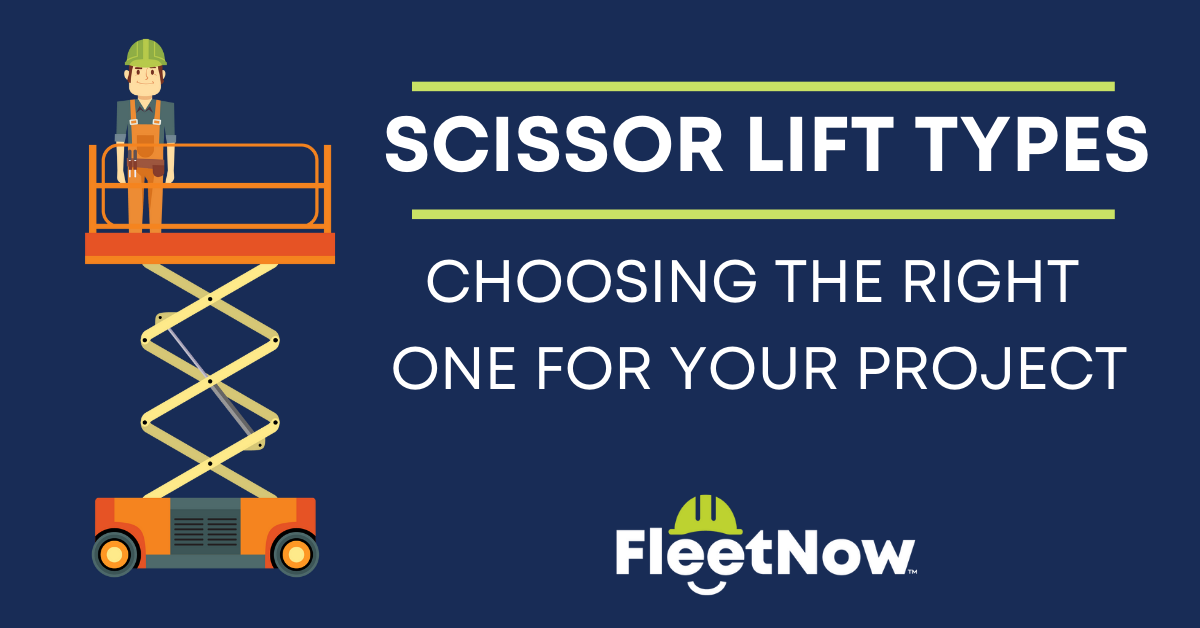
A scissor lift has a work platform on top of a set of linked, folding supports called a scissor stack. Hydraulic cylinders (or, on some small models, an electric actuator) push the stack open to raise the platform and let it fold back down to lower it. Because the platform only moves straight up, scissor lifts are stable, simple to run and carry more weight and more people than most boom lifts of similar height.
Most scissor lifts can be driven at full height on firm, level ground, which makes them fast for ceiling, wall and overhead work. If you need to reach up and over something, look at boom lifts instead. For very tight indoor spaces, a vertical mast lift may fit where a scissor will not.
Scissor Lift Types
| Type | Power | Best for | Guide |
|---|---|---|---|
| Electric slab scissor lift | Battery | Indoor work on smooth, level floors; non-marking tires and no exhaust | Electric scissor lifts |
| Rough terrain scissor lift | Diesel, dual fuel or hybrid | Outdoor job sites; four-wheel drive, oscillating axles and outriggers on many models | Rough terrain scissor lifts |
| Micro and compact scissor lift | Battery | Very tight spaces, doorways and elevators | MEC Micro 19 |
| Push-around (manual) scissor lift | Battery lift, pushed by hand | Light maintenance work at low heights | Hy-Brid scissor lifts |
For a side-by-side look at every type, see scissor lift types.
Scissor Lift Sizes and Used Prices
Scissor lifts are named mostly by platform height. Working height is about 6 feet higher than the platform height. Model numbers usually show platform height first and width second; a Genie GS-2632 has a 26 ft platform and is 32 inches wide.
| Platform height | Common widths | Popular models | Typical FleetNow median prices | Guide |
|---|---|---|---|---|
| 19 ft | 30 to 32 in | JLG 1930ES, Genie GS-1930, Skyjack SJ3219, MEC Micro 19 | About $5,000 to $9,900 | Used 19 ft scissor lifts |
| 26 ft | 32 or 46 in | Genie GS-2632, Skyjack SJ3226, JLG 2632ES, Skyjack SJ4626 | About $6,700 to $10,000 | Used 26 ft scissor lifts |
| 32 ft | 32 or 46 in | Genie GS-3232, Genie GS-3246, Skyjack SJ4632, JLG 3246ES | About $8,400 to $12,100 | Used 32 ft scissor lifts |
| 40 ft and up | 47 in slab, 69 in or wider RT | Genie GS-4047, Skyjack SJ4740, Genie GS-4069 RT | About $12,000 to $21,700 | Used 40 ft scissor lifts |
| Rough terrain, 26 to 53 ft | 69 in and wider | Genie GS-2669 RT, GS-3369 RT, GS-5390 RT, Skyjack SJ6832 RT | About $14,700 to $22,000 for popular models | Rough terrain scissor lifts |
Prices are medians for the most-listed models in each size from FleetNow listings in October and November 2026; see each guide for model-by-model ranges. Prices depend on year, hours, battery condition and location, so check current scissor lift listings.
Scissor Lift Brands
Genie, Skyjack, JLG and MEC build most of the scissor lifts in North American rental fleets, so they are also the most common on the used market. Parts and service are easiest to find for these brands.
| Brand | FleetNow listings (Nov 2026) | Brand guide | Inventory |
|---|---|---|---|
| Genie | About 3,950 | Genie scissor lifts | Shop Genie |
| Skyjack | About 2,690 | Skyjack scissor lifts | Shop Skyjack |
| MEC | About 1,680 | MEC scissor lifts | Shop MEC |
| JLG | About 750 | JLG scissor lifts | Shop JLG |
| Haulotte | About 190 | Haulotte scissor lifts | Shop Haulotte |
| LGMG | About 140 | LGMG scissor lifts | Shop LGMG |
| Snorkel | About 140 | Snorkel scissor lifts | Shop Snorkel |
| Hy-Brid Lifts | 16 | Hy-Brid scissor lifts | Shop Hy-Brid |
Listing counts change daily. FleetNow also lists scissor lifts from JCB, Sinoboom, Pettibone, XCMG and others.
Popular Scissor Lift Models
Detailed specs, prices and buying tips for the models we see most often:
- 19 ft: Genie GS-1930, JLG 1930ES, Skyjack SJ3219, MEC Micro 19, JLG 1932R, Pettibone AS1932E, and the 1930ES vs GS-1930 vs SJ3219 comparison
- Compact: MEC 1330SE
- 26 ft: Genie GS-2632, JLG 2632ES, Skyjack SJ4626
- 32 ft: Genie GS-3232, JLG 3246ES, JLG 3248RS, Skyjack SJ4632
- 40 ft and up: Skyjack SJ4740, MEC 4046SE, MEC 4555SE
- Rough terrain: Skyjack SJ6826 RT, Skyjack SJ6832 RT, Skyjack SJ7127 RT, Genie GS-5390 RT
Common Uses
- Electrical, lighting, HVAC, sprinkler and data cabling work overhead
- Drywall, ceiling grid, painting and finishing in commercial construction
- Warehouse, retail and facility maintenance
- Signage, glazing and exterior work (rough terrain models outdoors)
- Event and stage setup, and film and TV production
Rental yards keep large scissor fleets because the same machines serve all of these trades. See why rental yards are a good place to buy used equipment.
Buying a Used Scissor Lift
Most used scissor lifts come out of rental fleets, so condition varies more than age or hours suggest. Before you buy, check:
- Maintenance and inspection records, including the most recent annual inspection.
- Batteries: age, charging history and whether the lift runs a full shift; replacement packs are a common added cost.
- Tires and wheels: chunking, flat spots and wear on non-marking tires.
- Leaks: hydraulic fluid under the lift, at the cylinder or around the pump.
- Scissor stack: pins, bushings, cracks and bent arms; check that the platform lifts and lowers smoothly.
- Safety systems: tilt alarm, pothole guards, emergency lowering, platform gate and controls.
- Decals and serial plate: model year, capacity and indoor or outdoor rating.
Our used scissor lift buying guide covers the four questions to ask any seller, and the FleetNow inspection app helps document a machine’s condition with photos and checklists.
Safety, Inspections and Maintenance
In the US, OSHA treats scissor lifts as mobile scaffolds, and the ANSI A92 standards set the design, training and inspection rules for mobile elevating work platforms. Operators need training on the specific type of lift, a pre-use inspection before every shift, and a frequent and annual inspection by a qualified mechanic. Scissor lifts rely on guardrails for fall protection; follow the manufacturer’s manual and your employer’s rules on harnesses.
- Scissor lift FAQs: heights, safety rules, training and prices
- Scissor lift inspection checklist: daily, frequent and annual
- Rough terrain scissor lift inspection checklist
- Scissor lift maintenance schedule
- How to prevent scissor lift problems
- Electric scissor lift problems and fixes
- Genie GS-1930 operation guide
Video: Introduction to Scissor Lifts
This overview from IVES Training Group explains the parts of a scissor lift and how it is used. It does not replace hands-on operator training.
Shop Used Scissor Lifts With FleetNow
FleetNow lists used scissor lifts from rental fleets and dealers across the US and Canada. Browse all used scissor lifts, slab scissor lifts or rough terrain scissor lifts, or shop by brand: Genie, Skyjack, MEC and JLG.
Buying a truckload for a rental yard, or looking for something specific? Contact us or call 1-216-973-5124. Selling lifts from your fleet? List your equipment on FleetNow.
Scissor Lift FAQs
Scissor lifts raise workers, tools and materials straight up for overhead work such as electrical, HVAC, drywall, ceiling, painting, warehouse and facility maintenance. Rough terrain models handle outdoor construction sites.
Hydraulic cylinders push a set of crisscrossing supports, called the scissor stack, open to raise the platform and let it fold down to lower it. The platform moves straight up and down, which keeps the lift stable.
Common electric slab scissor lifts have platform heights of 19 to about 45 feet. Rough terrain models go higher, such as the Genie GS-5390 RT at 53 feet. Working height is about 6 feet above the platform height.
Electric slab scissor lifts run on batteries with non-marking tires for smooth indoor floors. Rough terrain scissor lifts are wider and heavier, usually diesel or dual fuel, with four-wheel drive and often outriggers for outdoor job sites.
On most models the first two digits are the platform height in feet and the last two are the width in inches. A Genie GS-2632 has a 26 ft platform height and is 32 inches wide.
On FleetNow in late 2026, median prices for popular used 19 ft scissor lifts were about $5,000 to $9,900, 26 to 32 ft models about $6,700 to $12,100, and rough terrain models about $14,700 to $22,000. Price depends on year, hours, batteries and condition.
Genie, Skyjack, MEC and JLG make most of the scissor lifts in North American rental fleets and on the used market. Haulotte, LGMG and Snorkel are also common.
Yes. Operators need training on the type of lift they use, along with familiarization with the specific model and a pre-use inspection before each shift, under OSHA rules and the ANSI A92 standards.